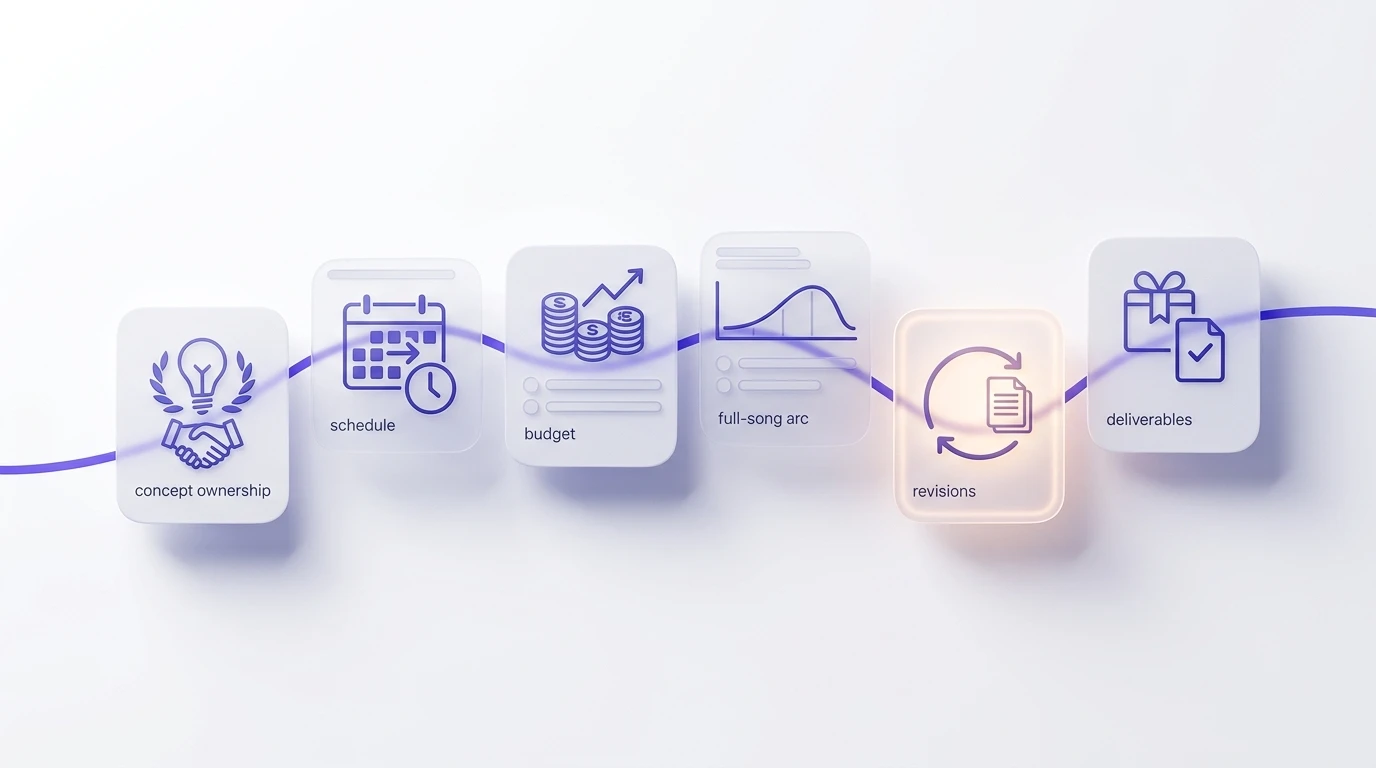

Planning video production in Denver around a release date means judging the delivery plan alongside the reel. YouTube supports scheduled publishing, so file handoff and public launch are separate milestones. Compare production routes against approval deadlines, then work backward to protect the full-song edit and platform checks.
- Set an accepted-master deadline before your public release date. Leave room for upload checks and corrections.
- Confirm whether the concept requires a real performance or a specific location before comparing production routes.
- Put the full-song master, social adaptation, and feedback deadlines in the quote. An export promise without an approval schedule leaves the release exposed.
What should you compare before choosing a team?
For a release video, the strongest proposal shows convincing full-song work and a believable path to an accepted master. A striking reel earns attention. It does not prove that a team can sustain your song’s pacing or meet your approval deadline.
Ask to watch a complete video close to your intended format. Look at the quieter passages. Does the visual world hold together when the chorus ends, or does the edit run out of ideas before the final section?
Then inspect the schedule. Ask which dates depend on location access or outside collaborators, and who can approve the work when your usual contact is unavailable. Our guide to choosing a video production company gives you a broader evaluation framework, but a fixed release date makes unresolved dependencies especially costly.
Name a final approver before requesting a schedule. A label manager and artist sending conflicting notes can stall an edit even when the production team has delivered on time.
Which production route fits your release?

Choose the production route around what must appear on screen. An authentic filmed performance needs a camera crew. A conceptual visual world may suit remote, AI-assisted production, provided someone owns the direction and final edit.
The ratings below are planning judgments about each route’s structure, not scores for individual providers. “Conditional” means you need evidence or written confirmation before relying on that capability.
| Production route | Deadline control | Authentic filmed performance | Full-song pacing control | Choose or skip |
|---|---|---|---|---|
| Local full-service production | Conditional on crew, location, and shoot availability | Strong | Strong when an editor is included | Choose for filmed performance or a specific setting. Skip if shoot logistics cannot fit the deadline. |
| Freelance videographer with editing | Conditional on individual capacity and backup cover | Strong | Conditional on editing scope and experience | Choose for a contained shoot. Skip if capture and editing responsibilities remain unclear. |
| Human-directed, AI-assisted production | Stronger when physical shoot dependencies are removed; still depends on approvals | Weak for documenting a real performance | Conditional on direction, continuity work, and human editing | Choose for a constructed visual world. Skip when authentic footage is essential. |
A Denver video production company makes sense when access to a real place materially improves the video. Ask who handles location permission before booking the shoot. The Colorado Office of Film, Television and Media is a useful starting point for production guidance; confirm requirements with the authority responsible for the actual location.
A remote workflow removes the need to coordinate a shoot. It still needs creative discipline. Request evidence that character appearance and visual style remain coherent across a full song, rather than judging isolated clips.
At SongTrailer, one creative director owns the concept through final edit. Our AI music video for artists package costs $3,500, covering a full-song master and social-ratio adaptation, with delivery in about 5-7 business days after intake and direction lock. That window should not be treated as spare time for an unresolved brief.
How do you schedule video production in Denver backward?
Start with the public release date and work backward to the last acceptable master delivery. The production team should attach actual calendar dates to the approval stages, including time for your response.
Your accepted-master deadline must leave room for platform processing and correction. YouTube explains that higher-quality video processing can take longer, so a completed upload does not necessarily mean the intended playback quality is ready.
Use this backward-planning worksheet when requesting proposals:
| Milestone, working backward | What must be complete | What to confirm |
|---|---|---|
| Public release | Approved video is ready to become public | Publishing owner and time zone |
| Platform verification | Uploaded file has processed and plays correctly | Audio sync, ending, and intended playback quality |
| Accepted master | Final export has passed your review | Correction window before platform verification |
| Picture lock | Shot order and timing are approved | Which finishing changes remain allowed |
| First full-song cut | The complete song has an editable visual structure | Feedback deadline and refinement rounds |
| Direction lock | Treatment and visual approach are approved | Production start date and remaining dependencies |
Ask the producer to place any shoot date between direction lock and the first-cut deadline. For location work, require a weather fallback that preserves the concept. Moving an outdoor performance indoors can change the lighting plan enough to require fresh preparation.
A treatment is the written and visual plan for the video. Lock it before production starts, but make the approval specific: approve the visual approach and how it develops across the song. Our guide to music videography from treatment to final master explains those handoffs, which helps prevent a late change of concept from being treated as a routine edit note.
If the dates do not fit, reduce complexity before production begins. Fewer locations can preserve the central idea while removing travel and setup dependencies. Cutting review time leaves you with less opportunity to catch mistakes.
What belongs in the production quote?
A useful quote defines the finished assets and the work required to accept them. A total price alone gives you little protection against scope disputes.
For a release video, ask the producer to document the following:
| Scope item | What the written quote should establish |
|---|---|
| Full-song master | The exact audio version, complete runtime, and export specifications |
| Social adaptation | Required aspect ratio and whether the edit will be reframed or reworked |
| Refinement rounds | What each round covers and when consolidated feedback is due |
| Schedule changes | What happens if assets arrive late or direction changes after approval |
| Additional costs | Which changes trigger a new quote or extra charge |
| Handoff and rights | Delivered-file ownership, permitted uses, and any asset restrictions |
A social adaptation deserves its own review. Cropping a wide composition can remove a performer’s face or make an important visual unreadable. Confirm how the team will preserve the focal point in the requested ratio.
Ownership also needs precise language. Receiving an exported file does not automatically settle rights to project files or third-party assets. The U.S. Copyright Office’s AI guidance distinguishes human authorship from AI-generated material, so file ownership should not be presented as a guarantee of copyright protection for every visual element.
Compare bids against the same accepted outcome. A cheaper quote that omits full-song editing or social adaptation may leave essential work outside the budget.
Frequently Asked Questions
What is the difference between videography and video production? Videography usually centers on camera capture. Full video production can also include concept development and post-production, so confirm responsibilities rather than treating either title as a complete scope.
How much does a release video typically cost? The cost depends on the production method and the agreed deliverables. Ask for a written total against a fixed brief, including any conditions that could increase the price.
Can production begin before the final song master is ready? Concept work can begin from a reference mix. Lock the exact audio file before timed editing, because a changed intro or ending can force revisions across the video.
What if the video cannot be finished before the song releases? Give the video a separate, confirmed premiere date rather than publishing unfinished work. Use approved promotional material in the gap, with a clear route back to the released track.
Choose the route that serves the song, then put real approval dates behind it. If your finished track needs a full-song visual without a location shoot, get in touch with SongTrailer with your release date and intended formats. Bring those requirements into the conversation before committing your launch calendar.