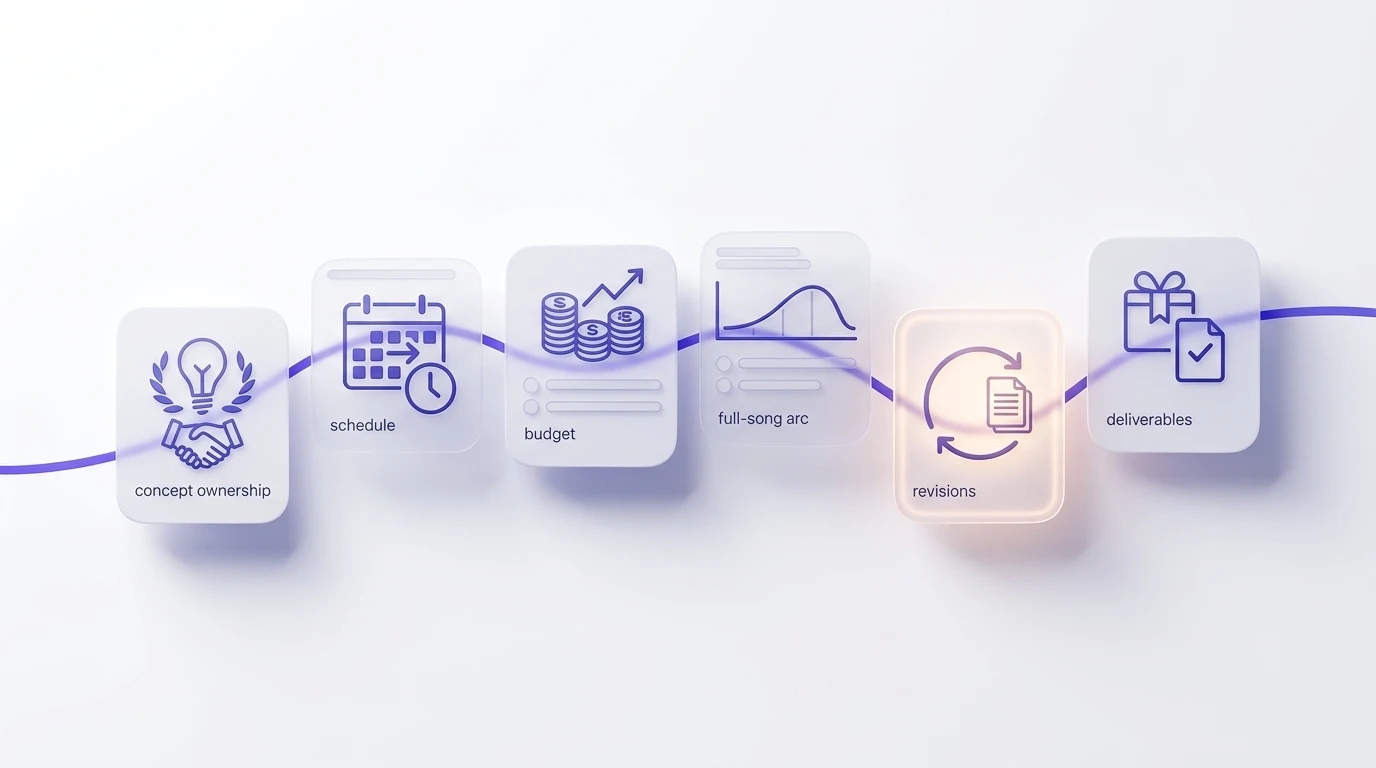
Choose a video production company by testing six things before discussing style: treatment ownership, schedule certainty, budget exposure, full-song capability, revision terms, and delivered formats. For context, SongTrailer's AI-assisted music video package documents a $3,500 flat price and delivery in about 5-7 business days after intake and direction lock.
- Require a director treatment that explains narrative, visual rules, pacing, and feasibility. A mood board alone does not prove the team can carry a full song.
- Compare total delivery scope, including the primary master, social-ratio adaptation, refinement rounds, usage rights, and project-file terms.
- Reject schedules built around an edit deadline alone. Concept approval, pre-production, asset creation, post-production, review time, and final exports all need space.
- Choose a conventional shoot only when the concept justifies its crew and logistics. Choose AI assistance only when a human director owns continuity and the final edit.
What should you evaluate in a video production company?
A video production company should be evaluated on its decision-making structure before its reel. Strong cinematography can produce beautiful frames while weak direction produces a disconnected video. For a finished single, the essential question is whether one person owns the visual idea from the creative brief through the primary master.
Start with the distinction between a creative brief and a director treatment. The brief comes from the artist or label. It defines the track, audience, release date, references, brand boundaries, available assets, and required deliverables. The treatment is the provider's interpretation of that brief.
A useful treatment should explain the visual world, scene progression, recurring motifs, performance approach, transitions, pacing, and technical method. It should also expose limitations. If the concept depends on a location, cast, costume, vehicle, choreography, or visual effect, the treatment should identify that dependency before approval.
Use this evaluation framework before requesting proposals:
| Criterion | What a credible proposal should answer | Warning sign |
|---|---|---|
| Treatment ownership | Names the director responsible for concept and continuity | Several contributors, no final creative owner |
| Schedule certainty | Maps direction lock, production, reviews, and masters to the release date | Promises a final date without approval deadlines |
| Budget transparency | States inclusions, exclusions, and change costs | Low estimate with open-ended production hours |
| Full-song capability | Shows how the concept develops across the complete track | Reel consists mainly of teasers and short loops |
| Revision terms | Defines refinement rounds and what counts as a new direction | "Revisions included" with no boundaries |
| Format delivery | Lists resolution, aspect ratio, codec, captions, and clean versions | "Social cutdowns available" without specifications |
Watch a provider's previous work with the audio muted, then listen without looking. The first pass reveals composition and visual continuity. The second reveals whether edits follow phrases, transitions, tension, and release rather than cutting on every obvious beat.
That matters for restrained genres. Effective R&B music videos, for example, may hold on a performance or image longer than an aggressive pop edit would. Pacing should serve the record, not the editor's showreel.
How do video production company models compare?

Video production company models differ mainly in where cost and creative responsibility sit. A conventional production company builds around physical production. A freelancer concentrates responsibility in one person. An automated platform reduces manual work. A human-directed, AI-assisted studio puts the director at the center while using generative tools for visual production.
The ratings below describe the typical structure of each model. Individual providers can perform above or below their category.
| Model | Treatment ownership | Schedule certainty | Budget transparency | Full-song capability | Revision clarity | Format delivery |
|---|---|---|---|---|---|---|
| Conventional production company | High when a director is attached | Medium | Medium | High | Usually defined | Usually broad |
| Solo freelancer | Variable | Low to medium | Medium | Medium to high | Often informal | Depends on workflow |
| Automated AI platform | Low | High | High | Low to medium | Tool-dependent | Often template-based |
| Human-directed AI-assisted studio | High | High after direction lock | High with a flat package | High | Should be defined | Strong when included |
Conventional production can deliver real locations, performers, choreography, practical lighting, and controlled cinematography. It also carries crew rates, equipment, permits, transport, insurance, catering, talent, and location costs. Those costs are reasonable when the creative idea depends on physical performance or a place the audience must believe.
Freelancers can be a strong choice for intimate performance videos, documentary footage, or a lean concept built around one location. Their weakness is capacity. If the same person directs, shoots, edits, grades, exports, and manages feedback, illness or an overrun on another job can threaten the release calendar.
Automated tools suit visualizers and rapid social assets. They become risky when nobody owns character consistency, shot progression, or the relationship between verses and choruses. Generating more clips does not repair a weak visual structure.
A human-directed AI-assisted workflow can create a larger visual world without organizing a physical shoot. The useful distinction is human control: concept, image selection, pacing, continuity, and the human edit must remain owned. Our creative direction model at SongTrailer assigns one creative director from brief through final delivery rather than passing the track between disconnected operators.
Who should choose each production model?
The right production model follows the concept, release risk, and required realism. Budget matters, but choosing by price alone often shifts cost into reshoots, missed dates, weak revisions, or assets that cannot be used across platforms.
Conventional video production studio
A video production studio is the right choice when the idea depends on real performance, precise cinematography, production design, choreography, or a recognizable location. A band playing live in a warehouse, a dance sequence with complex blocking, or a narrative driven by actor performances needs a physical set and an experienced crew.
Skip a conventional shoot when the concept does not justify the logistics. Paying for a large crew to capture a generic lip-sync setup rarely improves the idea. Location also changes the budget: teams in Los Angeles, Chicago, Boston, San Francisco, or London must account for local crew rates, travel, permits, and availability rather than quoting post-production alone.
Solo freelancer
A freelancer fits a contained concept with modest logistics and a release schedule that has room for uncertainty. One experienced director-editor can make a focused video feel personal and coherent.
Ask what happens if production slips. Confirm whether color grade, sound synchronization, title design, cleanup, and social exports are done personally or subcontracted. The answer affects both timing and consistency.
Automated platform
Automation fits lyric loops, visualizers, background motion, and low-risk experiments. It is less suitable for a priority single that needs recognisable direction across the full track.
Skip automation when character continuity, narrative progression, or brand-sensitive imagery matters. Prompt controls are production inputs. They do not replace a director treatment or a disciplined post-production edit.
Human-directed, AI-assisted studio
An AI-assisted studio suits finished tracks that need cinematic scale, predictable costs, remote production, and a short release runway. It works particularly well when the concept calls for surreal locations, stylized environments, or visual transformation that would be expensive to build physically.
The provider still needs editorial judgment. Review its process for shot selection, consistency, pacing, refinement, and exports. A serious full-song AI music video workflow for artists should explain where human direction controls the generated material rather than treating generation as the finished product.
Which contract and delivery limitations deserve scrutiny?
A music video contract should define what is being created, who can use it, what files are delivered, and what happens when the approved direction changes. Ambiguous ownership language causes more trouble than a missing camera specification.
Usage rights deserve a direct clause. Commissioning and paying for a video does not automatically settle every copyright question under US law. The US Copyright Office's work-made-for-hire guidance explains that qualifying commissioned works require specific conditions and a signed written agreement. Ask who owns the finished master, whether the provider retains portfolio rights, and whether third-party footage, fonts, models, or music-adjacent assets carry separate restrictions.
Project files are a separate issue. Ownership of the delivered video does not necessarily include edit timelines, source footage, generated assets, layered compositions, color files, or working project folders. If future recuts matter, negotiate project-file delivery before production begins. Some workflows depend on licensed plugins, cloud tools, or model access that cannot transfer cleanly.
The delivery schedule should distinguish these milestones:
| Milestone | What should be approved or delivered |
|---|---|
| Intake complete | Final audio, lyrics, credits, brief, references, release date |
| Direction lock | Approved treatment, visual boundaries, production method |
| First full cut | Complete song structure with representative finishing |
| Refinement | Consolidated notes within the agreed scope |
| Primary master | Approved full-resolution release file |
| Social-ratio adaptation | Reframed or re-edited version for the agreed platform ratio |
| Archive handoff | Masters, specified alternates, captions, and any contracted source files |
A social-ratio adaptation should be more than an automatic center crop. A widescreen composition may place the artist, typography, or narrative action outside a vertical frame. Proper adaptation can require reframing, repositioning, alternate shots, or a distinct edit.
Specify aspect ratio and resolution in writing. YouTube's official video formatting guidance explains how its player handles different aspect ratios, but platform compatibility does not guarantee a good composition. The creative team must protect the focal point in every promised format.
Revision language also needs precision. A refinement round usually covers timing adjustments, shot substitutions from available material, minor grading changes, and typography corrections. A new location, character, storyline, or visual language is a direction change. Providers should price that distinction openly rather than arguing about it after the first cut.
How should you shortlist a video production company?
Shortlist a video production company by sending every candidate the same release brief. Unequal briefs produce unequal proposals, which makes the cheapest quote look more complete than it is.
The brief should include the final mastered track, accurate lyrics, release date, intended audience, artist positioning, reference videos, prohibited imagery, existing artwork, and required deliverables. Mark references by attribute. "Use the camera movement from one reference and the color restraint from another" is actionable; "make it feel cinematic" is not.
Ask each candidate to return a treatment, delivery schedule, fixed scope, change-cost policy, rights summary, and exact master specification. Then compare assumptions. One quote may include pre-production, post-production, color grade, title design, and vertical adaptation, while another covers only filming and a widescreen edit.
Protect the release date by setting internal approval deadlines. Label and artist feedback should arrive as one consolidated note set, with one person authorized to approve direction. Contradictory notes consume the revision window and leave the editor solving internal disagreements instead of improving the video.
The strongest proposal makes the production method easy to inspect. You should know who directs, who edits, when the concept locks, what can still change, and exactly which files arrive at delivery.
Frequently Asked Questions
What is the difference between videography and video production?
Videography usually refers to capturing footage, often with a small crew or single operator. Video production covers the complete process: creative development, treatment, pre-production, filming or asset creation, editing, color, revisions, and master delivery.
How much does music video production typically cost?
Cost depends on the concept, crew, cast, locations, equipment, visual effects, post-production, and usage requirements. Compare complete scopes rather than headline quotes, because a low filming fee may exclude editing, grading, revisions, travel, or platform adaptations.
How long does a full-song music video take to produce?
A conventional shoot may require substantial lead time for treatment development, crew booking, locations, production, and post-production. Remote and AI-assisted workflows can move faster, but turnaround should begin after the creative direction and required inputs are locked.
Should a production company provide project files?
Only when the contract says so. Finished masters and project files are different deliverables, and source projects may contain licensed tools, third-party assets, or technical dependencies that cannot be transferred.
What should a primary master include?
A primary master should specify duration, resolution, aspect ratio, frame rate, codec, audio format, and whether titles or captions are embedded. Any clean version, vertical adaptation, teaser, or alternate ending should appear as a separate contracted deliverable.
Your release visual should have one accountable direction, a schedule built around the release date, and delivery terms you can verify before production starts. If a human-directed, AI-assisted full-song video fits that brief, contact SongTrailer about your release.