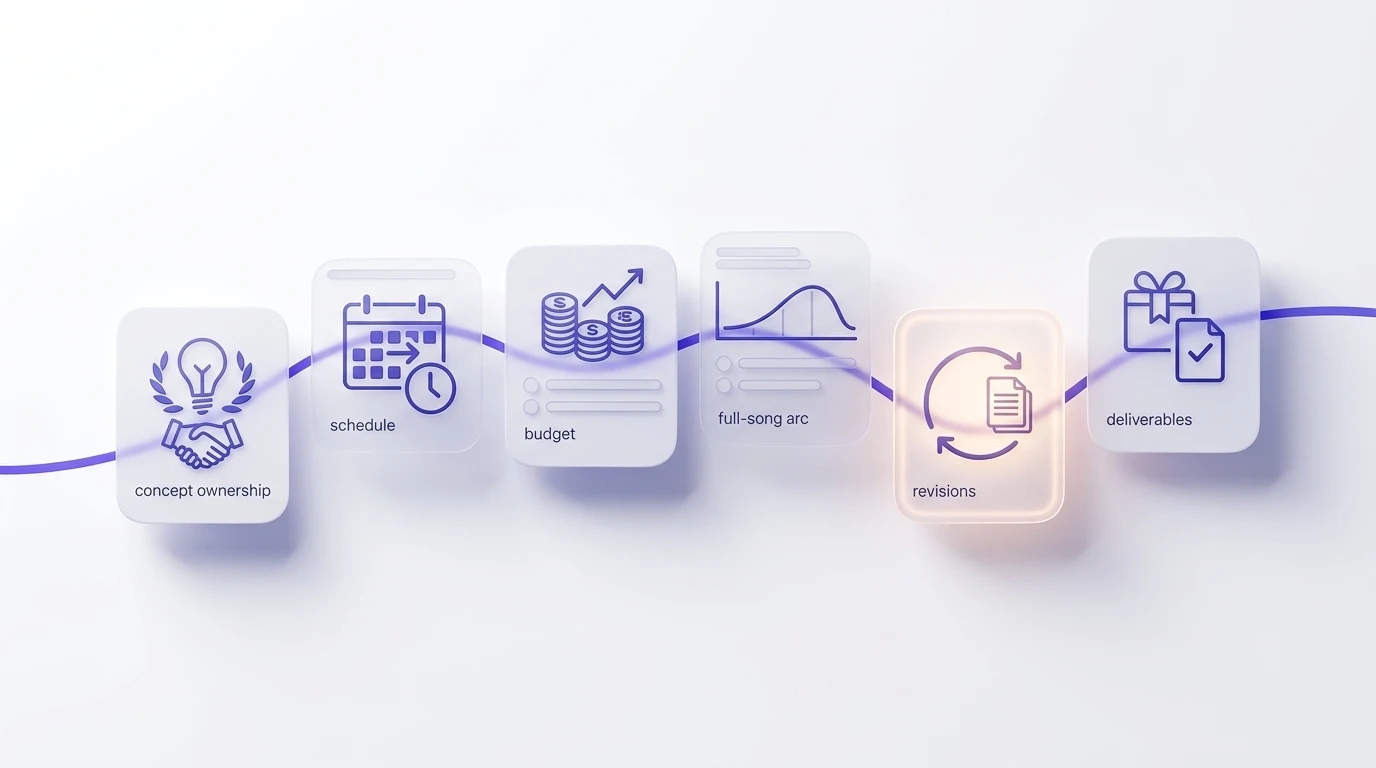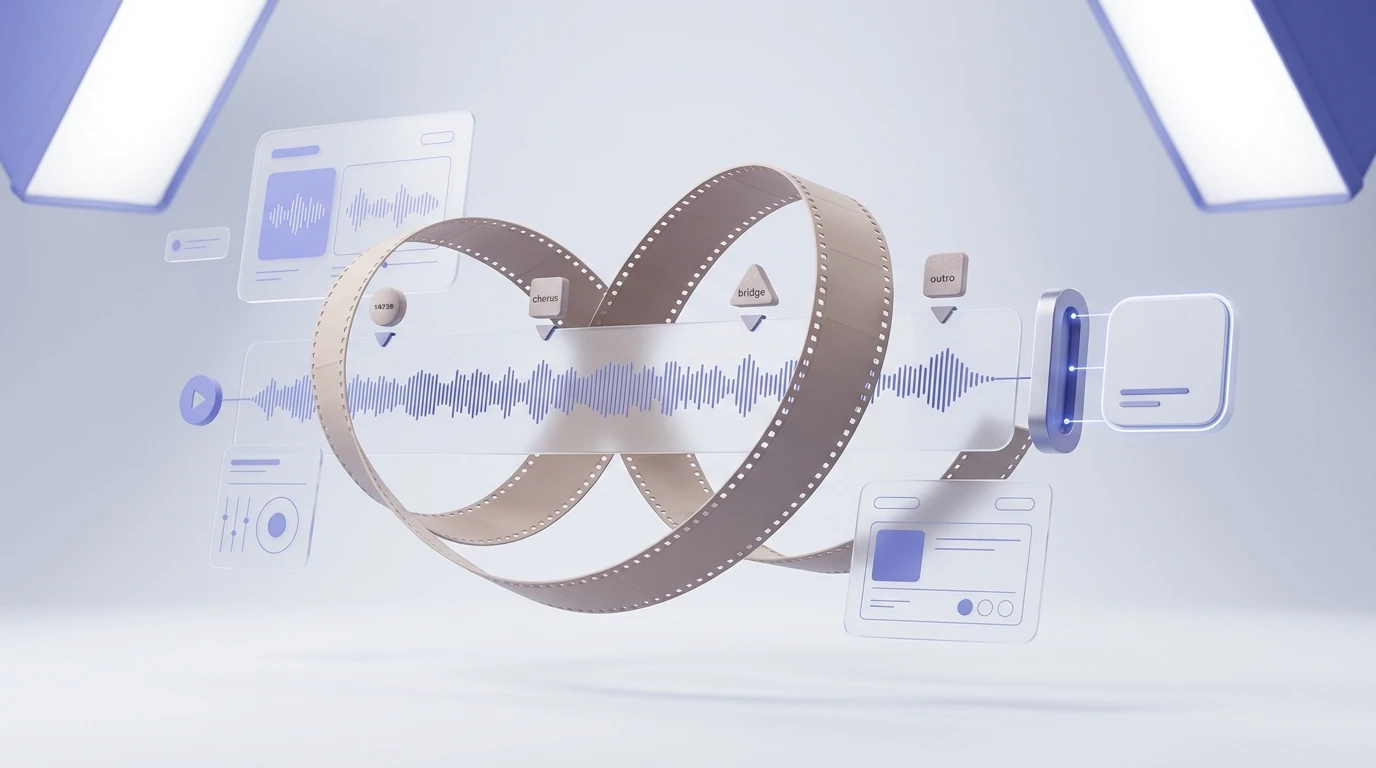
Music videography is the complete process of turning a finished track into a coherent full-song film, from creative brief and treatment through production, editing, and final delivery. At SongTrailer, one creative director owns that sequence from direction lock to final edit. This guide shows first-release artists what gets decided, filmed, refined, and approved.
- Lock the finished audio, visual direction, deliverables, and usage rights before production begins.
- Build the treatment around the song’s structure. Every scene needs a defined place in the emotional arc.
- Choose a production route based on the images the song requires, rather than copying the format of another artist’s video.
- Approve the final master only after checking sync, continuity, grading, effects, compression, credits, and social adaptations.
What does music videography include?
Music videography covers creative development, production, post-production, and delivery. The videographer or production team translates a finished recording into a timed visual sequence, then supplies approved files for release platforms and promotional use.
The process starts with prerequisites. The artist should have a locked audio master, confirmed song title, release plan, lyrics, brand assets, and a realistic approval chain. If a label, manager, featured artist, or distributor can reject the video, that person belongs in the review process from the beginning.
| Stage | Main decisions | Working output |
|---|---|---|
| Creative brief | Audience, mood, release purpose, visual boundaries | Approved brief |
| Direction | References, narrative device, performance style, visual rules | Treatment |
| Pre-production | Scenes, coverage, locations, wardrobe, props, logistics | Storyboard and shot list |
| Production | Performance, camera movement, lighting, continuity | Original footage or generated visual material |
| Post-production | Selects, pacing, sync, color, sound handling, VFX | Review cuts |
| Delivery | Encoding, aspect ratios, captions, credits, ownership | Primary master and adaptations |
A brief should explain what the viewer must feel at each major musical turn. “Dark and cinematic” gives a director almost nothing to work with. “The verses feel physically confined, while each chorus opens into a wider and less stable world” creates usable decisions for lenses, framing, movement, production design, and editorial rhythm.
References help define the visual language, but they need labels. Identify whether each reference is being used for color, camera movement, texture, wardrobe, performance, or pacing. A reference board filled with unrelated frames usually creates contradictions later.
Rights must also be settled. A music video may involve separate rights in the sound recording and musical composition, as explained in the U.S. Copyright Office’s guidance for musicians. Featured performers, locations, stock material, fonts, artwork, and third-party footage may need their own permissions. Clarify who owns the finished files and project assets in the production agreement.
Artists comparing teams should examine process ownership as closely as camera work. A practical framework for reviewing scope, approvals, rights, and deliverables appears in our guide to choosing a video production company.
How does a treatment become a shot-by-shot music videography sequence?
A music video treatment becomes filmable when each creative statement is attached to a section of the song, a visual action, and a production method. The treatment defines the world. The storyboard and shot list define how that world appears on screen.
Start by marking the locked track. Identify the intro, verse entries, pre-choruses, choruses, instrumental breaks, bridge, final lift, and outro. Add meaningful events inside those sections: a lyric reveal, drum fill, harmonic change, vocal pause, or new layer entering the arrangement.
The treatment can then assign a visual function to each section. A verse might establish character and geography. The first chorus can introduce scale. A bridge may interrupt the established grammar with a static frame, a new environment, or a severe color shift. Repeating the same coverage for every chorus wastes the song’s progression.
A storyboard controls composition and sequence. It shows framing, subject position, camera direction, transitions, and recurring visual motifs. It can use sketches, reference frames, still photography, or generated concept images, provided everyone understands that concept imagery is directional rather than a guaranteed final frame.
A shot list converts those boards into production instructions. Each shot needs a scene, framing, camera movement, performance action, lyric or timecode range, and continuity note. “Singer in warehouse” is too loose. “Medium profile from second verse entry through the final line, slow push-in, right hand on microphone, cool backlight active” is shootable.
Production design and continuity should be planned at this stage. Wardrobe condition, prop placement, eyeline, screen direction, weather, hair, makeup, and light direction can all expose a broken sequence. Visual continuity matters even in surreal work. The viewer needs stable rules before the director can break them deliberately.
Which production routes suit different songs and budgets?

The right production route depends on performance needs, visual specificity, schedule, and how much physical control the concept requires. Budget matters, but a cheaper method becomes expensive when it cannot produce the frames the treatment promises.
| Production route | Best suited to | Main constraint |
|---|---|---|
| Live-action performance | Strong performer presence, choreography, band chemistry | Crew, location, lighting, scheduling |
| Narrative live action | Character-led songs with physical story beats | Casting, coverage, continuity |
| Studio or virtual production | Controlled lighting and repeatable environments | Stage access and art direction |
| Animation | Graphic worlds, abstraction, precise transformation | Labor-intensive asset creation |
| AI-assisted visuals | Surreal environments, rapid visual iteration, impossible transitions | Character consistency and rights review |
| Hybrid production | Performance footage combined with generated, animated, or archival layers | Matching texture, motion, light, and color |
Live action remains the strongest choice when facial performance carries the song. The camera records small changes in breath, eye line, posture, and timing that are hard to manufacture later. It also demands preparation. Weak playback, incomplete coverage, or rushed lighting will follow the project into the edit.
AI filmmaking can produce environments and transformations that would require heavy physical production or conventional VFX. It still needs firm direction. Without shot architecture, continuity rules, and human editorial control, generated clips tend to feel like adjacent demonstrations rather than one film.
Copyright treatment also deserves scrutiny. The U.S. Copyright Office report on copyrightability and generative AI explains how human authorship affects protection in the United States. Artists should also review the commercial terms of every generation platform used in production.
SongTrailer’s approach to an AI-assisted full-song music video for artists assigns concept, pacing, and delivery to one human creative director. That model is most useful when a finished track needs a controlled visual world without the logistics of a traditional shoot.
How do direction and editing make a music video feel complete?
To make a music video feel complete, performance direction, cinematography, and editorial pacing must respond to the same song map. A beautiful close-up loses force if it arrives before the music has earned it.
Performance direction starts with intention. A singer may address the lens, play toward another character, or remain detached from the camera. Switching between those modes without a reason weakens the performer’s screen presence. Mouth shapes and body movement also need accurate playback when visible lip sync is expected.
Cinematography establishes visual grammar. Lens choice changes intimacy. Camera height changes authority. Movement changes energy. A handheld verse and locked-off chorus can work, but only when the contrast supports the song rather than displaying technique.
Coverage should give the editor both anchors and escape routes. Anchor footage carries recognizable performance or narrative action. B-roll supplies detail, atmosphere, transitions, and controlled departures from sync. Random inserts rarely solve an edit because they lack a defined relationship to the lyric, beat, or story.
Editorial pacing should follow musical pressure rather than cutting on every beat. Some cuts land on a vocal entrance. Others anticipate it by a few frames or hold past it to create resistance. Faster music can support long shots, while a sparse ballad may need abrupt interruption. The emotional logic decides.
Full-song structure makes repetition especially demanding. A recurring chorus can return to the same location while changing scale, camera distance, movement, or visual density. That preserves recognition without making the sequence feel duplicated.
What happens during post-production and revisions?
Post-production turns selected footage and generated material into a unified master. The editor controls timing first, then continuity, compositing, color, graphics, and technical finishing.
The first useful review cut should prove the whole song. Temporary effects are acceptable when clearly marked, but the sequence needs enough visual information to judge momentum and repetition. Reviewing isolated hero shots before the complete cut often leads to polished scenes that do not fit the track.
Notes work best when they are consolidated by one decision-maker and tied to timecodes. “More energy” invites guesswork. “At the second chorus entry, replace the static wide shot with closer performance coverage and shorten the preceding transition” gives the editor an actionable change.
Revision rounds should be defined before work begins. The agreement needs to distinguish a correction from a change in direction. Fixing a visible compositing edge belongs to quality control. Replacing an approved visual world after the edit has been built affects scope, schedule, and potentially the budget.
Color grading gives mixed material a common visual baseline. Exposure, contrast, skin tone, saturation, grain, and black levels should remain intentional across scenes. VFX and AI-assisted shots need the same scrutiny. Watch for warped details, drifting faces, unstable clothing, broken reflections, impossible shadows, or objects that change shape between cuts.
Timelines vary sharply by route. A location-heavy narrative shoot needs different preparation from a generated or hybrid film. For a defined production reference, SongTrailer publishes a $3,500 flat package with a full-song master and social-ratio adaptation, delivered in about 5-7 business days after intake and direction lock through its full-song production format. Those figures describe that specific package, not an industry-wide benchmark.
What should be checked before the music videography final master is approved?
Final-master approval should cover creative integrity, technical playback, rights, and deliverable ownership. Watch the video from beginning to end without stopping before inspecting individual frames. The uninterrupted viewing exposes pacing failures that frame-by-frame review can hide.
| Check | What to inspect |
|---|---|
| Picture lock | Correct sequence, no accidental placeholders, no missing shots |
| Sync | Lip sync, choreography, cut timing, and audio start point |
| Continuity | Wardrobe, props, eyelines, movement direction, generated characters |
| Color and VFX | Matching shots, clean masks, stable details, intentional grain |
| Text and credits | Spelling, legibility, safe placement, approved billing |
| Audio | Exact approved master, no level change, truncation, or duplicate audio |
| Encoding | Resolution, frame rate, codec, file integrity, platform playback |
| Deliverables | Primary master, social versions, caption files, thumbnails if contracted |
| Ownership | Final-file rights, project-file terms, archival responsibility |
The primary master should preserve the intended composition and highest approved quality. Platform versions should come from that master, rather than from a compressed social upload.
Aspect-ratio adaptation requires reframing, not simple cropping. A vertical version may need a different shot scale, repositioned titles, alternate cuts, or redesigned split screens. YouTube explains how standard computer playback uses a 16:9 aspect ratio in its video display and aspect-ratio guidance, while vertical platforms can prioritize a much narrower frame.
Encoding should follow the destination platform’s current requirements. YouTube’s recommended upload encoding settings specify supported containers, codecs, frame rates, and audio settings. Upload the actual delivery file to a private test environment and inspect it on both a large screen and a phone before release.
Ownership language needs precision. “The artist owns the video” may cover the rendered master while excluding editable project files, licensed stock, fonts, model releases, or reusable production assets. The contract should name what is delivered, what can be modified, and who stores the source material after approval.
Frequently Asked Questions
What is the difference between videography and video production?
Videography often refers to capturing and editing footage, while video production describes the larger process of creative development, pre-production, filming, post-production, and delivery. A professionally directed music video usually involves the full production process.
What is the visualization of music called?
It may be called a music video, visualizer, lyric video, animation, or audiovisual work. A visualizer usually relies on a repeating or reactive graphic system, while a full music video uses developed sequencing across the complete song.
What should an artist prepare before making a music video?
Prepare the locked audio master, lyrics, release date, creative references, available brand assets, approval contacts, and confirmed rights information. Also define the required master format and social adaptations before the treatment is approved.
How long does it take to make a music video?
The schedule depends on concept development, locations, casting, production method, effects, and review speed. Agree on dates for direction lock, production, first cut, consolidated feedback, picture lock, and delivery rather than relying on one final deadline.
How many revisions should a music video include?
There is no universal number. The contract should state the included refinement rounds, who submits consolidated notes, and which changes would alter the approved concept or production scope.
Striking frames earn attention. Controlled sequencing makes them belong to the same film. If your finished track needs a full-song visual built around one creative direction, get in touch with SongTrailer to review the production approach before your release schedule closes in.