
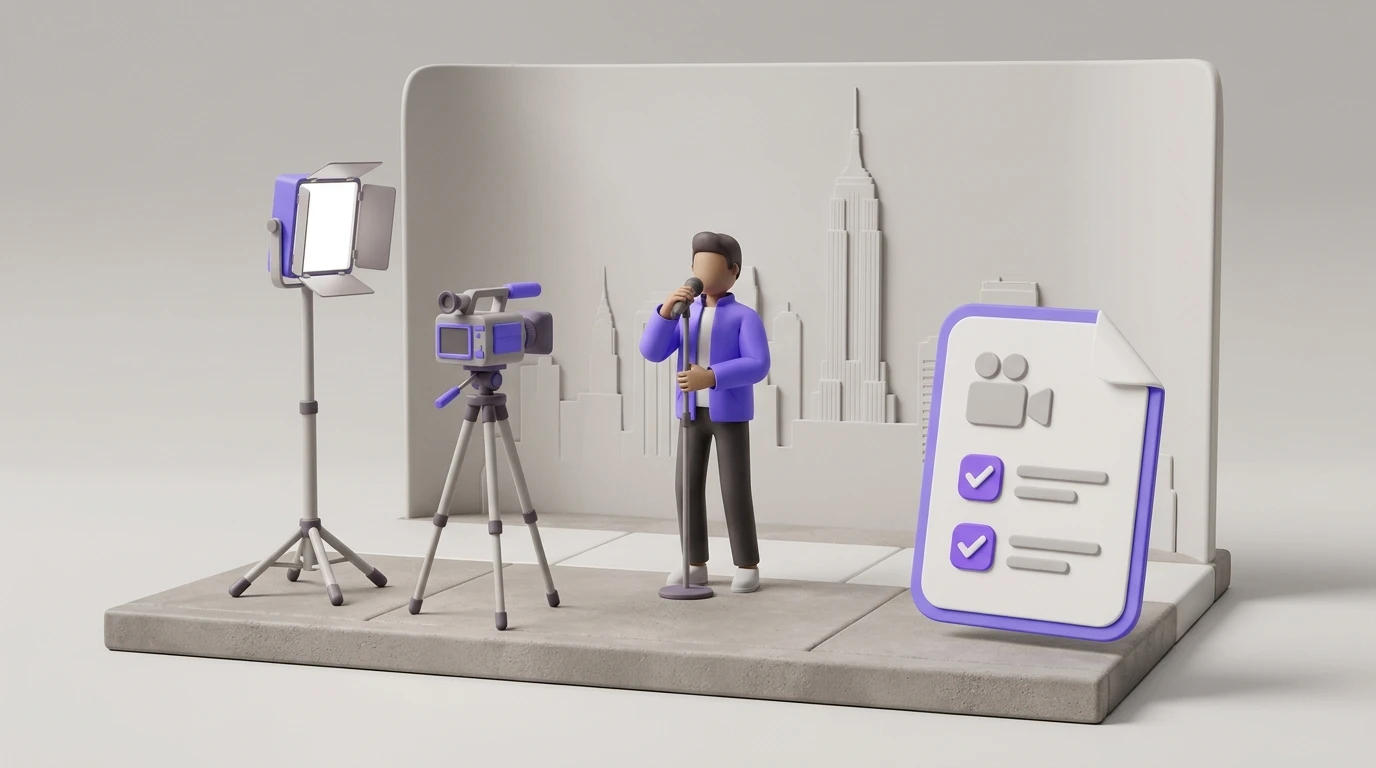
For New York City video production, NYC’s film office allows some handheld or tripod shoots without a permit when they need no exclusive use of city property. Larger equipment, production parking, or prop weapons can change that. Confirm the setup and location authority before booking the crew.
- Assess the whole production footprint. A tripod camera, a lighting stand, and reserved curb space raise different permit questions.
- Get approval from the authority that controls the location. A city film permit does not automatically grant access to parks, subway stations, or private buildings.
- Include setup and breakdown in the schedule you submit. The performance itself is only part of the location use.
- Check amplified playback separately. Film permission does not automatically cover a speaker playing the track on the street.
When does New York City video production require a permit?
The Mayor’s Office of Media and Entertainment, or MOME, sets permit requirements for filming on city property. The decision turns on the equipment and use of public space, including whether the production needs parking privileges or special assistance.
We recommend assessing the entire scene before deciding that a shoot is permit-exempt. Include the gear waiting off-camera and the space needed to run the performance.
| Planned setup | Permit implication | Production decision |
|---|---|---|
| Handheld camera or tripod, without exclusive use of city property | May qualify for an exemption under MOME’s rules | Check all exemption conditions and keep public passage open |
| Lighting stands, dolly track, or other placed production equipment | Generally requires a film permit on city property | Describe the equipment and its footprint in the application |
| Reserved production parking or exclusive use of city property | Requires a permit | Request the specific accommodation rather than assuming it comes with filming permission |
| Prop weapons, police uniforms, or stunts | Requires permit review and potentially additional coordination | Disclose the exact action before committing to the scene |
A tripod does not give the crew control of the sidewalk. If a clean frame depends on stopping pedestrians, that changes the location plan and needs review.
A small crew can still have a substantial footprint. A camera operator and performer may travel lightly, but adding a light stand and a production vehicle introduces different requirements.
Who controls your filming location?
Location permission comes from the authority or owner responsible for the property. MOME handles city filming permissions within its remit, but it cannot grant access to every place that appears on a New York location board.
For a public sidewalk or city street, start with MOME’s rules. Describe the actual activity, including any equipment placed outside a nearby private property.
For a park, check the NYC Parks film shoot request process alongside any MOME requirement. Park approval and city filming permission are separate checks, so confirm both before promising the artist a particular lawn, path, or waterfront view.
Subway locations fall under MTA rules. A city film permit alone does not authorize a staged performance on a platform or train.
A shoot contained entirely on private property generally does not need a MOME film permit, although owner consent and building rules still apply. Watch the boundary: moving a light onto the sidewalk or requesting street parking can bring city permissions back into the plan.
Get the location agreement in writing. It should identify the spaces available to the crew and the hours during which access is allowed.
What should you prepare before applying?
Prepare a stable production plan before submitting a film permit application. The reviewer needs a clear account of where the production will operate and what will happen there.
Start with the exact location boundaries. Include setup and breakdown in the requested hours, then describe the performance and all equipment that will occupy public space. Identify production vehicles and any requested parking accommodations.
Name the person responsible for the application. Our guide to choosing a video production company helps frame that responsibility before signing, especially when the artist assumes the producer handles permits and the producer assumes the label does.
For shoots requiring insurance, follow MOME’s film insurance requirements rather than sending a generic certificate. Have the broker check the required coverage and additional-insured wording against the city’s instructions.
Confirm the current application fee and submission deadlines before locking the production budget. Separate the permit charge from location access and any required agency services. They are different costs.
An application is not an approval. Make location commitments conditional where possible, and leave room in the release schedule for review or changes.
A worked permit plan for a sidewalk music shoot
Suppose an artist wants a daylight sidewalk performance for a finished single. The plan uses a tripod camera and a battery-powered light on a stand, with speaker playback for lip-sync. No production parking is requested.
The lighting stand is the equipment issue to resolve. Battery power does not turn a placed fixture into handheld equipment.
If the director keeps that setup, the producer should pursue the MOME permit route, include the stand’s position in the location plan, and arrange the required insurance. The crew must also preserve public passage and check the playback requirements with the local precinct.
If the director removes the stand, the producer should reassess the complete setup against MOME’s exemption criteria. Removing equipment changes the plan, but the remaining activity still needs to qualify.
Keep the creative treatment and permit brief aligned. A treatment-to-final-master workflow helps connect the planned performance to the eventual edit, so a late creative change does not quietly expand the approved footprint.
Use this brief before applying or requesting a production quote. Replace every bracketed field with a concrete answer.
MUSIC SHOOT PERMIT BRIEF

Project:
[Artist, track title, and intended video use]

Location and authority:
[Exact address, filming boundaries, and responsible owner or agency]

Schedule:
[Date, setup hours, filming hours, and breakdown hours]

On-camera action:
[What the performer and any other participants will do]

Equipment footprint:
[Camera support, lights, stands, cables, power, and gear storage]

Public access:
[How pedestrian passage and building entrances will remain usable]

Vehicles and parking:
[Production vehicles, loading needs, and requested parking privileges]

Sound:
[Playback equipment and any sound-permit requirements to confirm]

Special activity:
[Props, uniforms, stunts, effects, or other activity requiring review]

Application and insurance lead:
[Responsible person, contact details, and submission responsibilities]

Required approvals:
[MOME, property owner, park authority, MTA, precinct, or other authority]

Fallback:
[Alternative setup or location, with its own permission check]
How should you handle playback and on-set changes?
Amplified playback needs its own planning check. A film permit does not automatically authorize a speaker-based performance, and NYC’s Noise Code guidance remains relevant to the shoot.
Confirm with the local NYPD precinct whether the proposed playback needs a sound device permit. Explain where the speaker will sit and when it will operate. Keep playback limited to what the performance requires.
For lip-sync, the performer needs a reliable reference. Decide how to provide it before the shoot rather than arriving with an oversized speaker and negotiating around complaints.
On set, work from the approved scope. Moving a light into the pedestrian route or adding a curbside vehicle can create a permit problem even when the camera position stays unchanged.
If the approved footprint cannot deliver the shot, contact the issuing authority before expanding it. A release date approaching quickly is a reason to simplify the setup early.
Frequently Asked Questions
Can I change locations after a film permit is approved?
A permit covers its approved locations and activity. Contact the issuing authority about an amendment or new application before moving the production to another location that requires permission.
Can I film a music video at night in NYC?
Night filming is possible, subject to approved hours and location-specific restrictions. Disclose the lighting and playback plan so the application reflects how the location will actually be used.
Does a film permit give me ownership of the finished music video?
No. A film permit authorizes specified filming activity, while ownership of the footage and delivered masters depends on production agreements and applicable rights. Put file delivery and usage rights in the contract before production begins.
For the sidewalk performance, resolve the lighting stand and playback plan before booking the location. If an AI-assisted visual world suits the track, get in touch about a full-song music video with SongTrailer, where one creative director guides the concept and human edit through delivery of a full-song master and social-ratio adaptation.