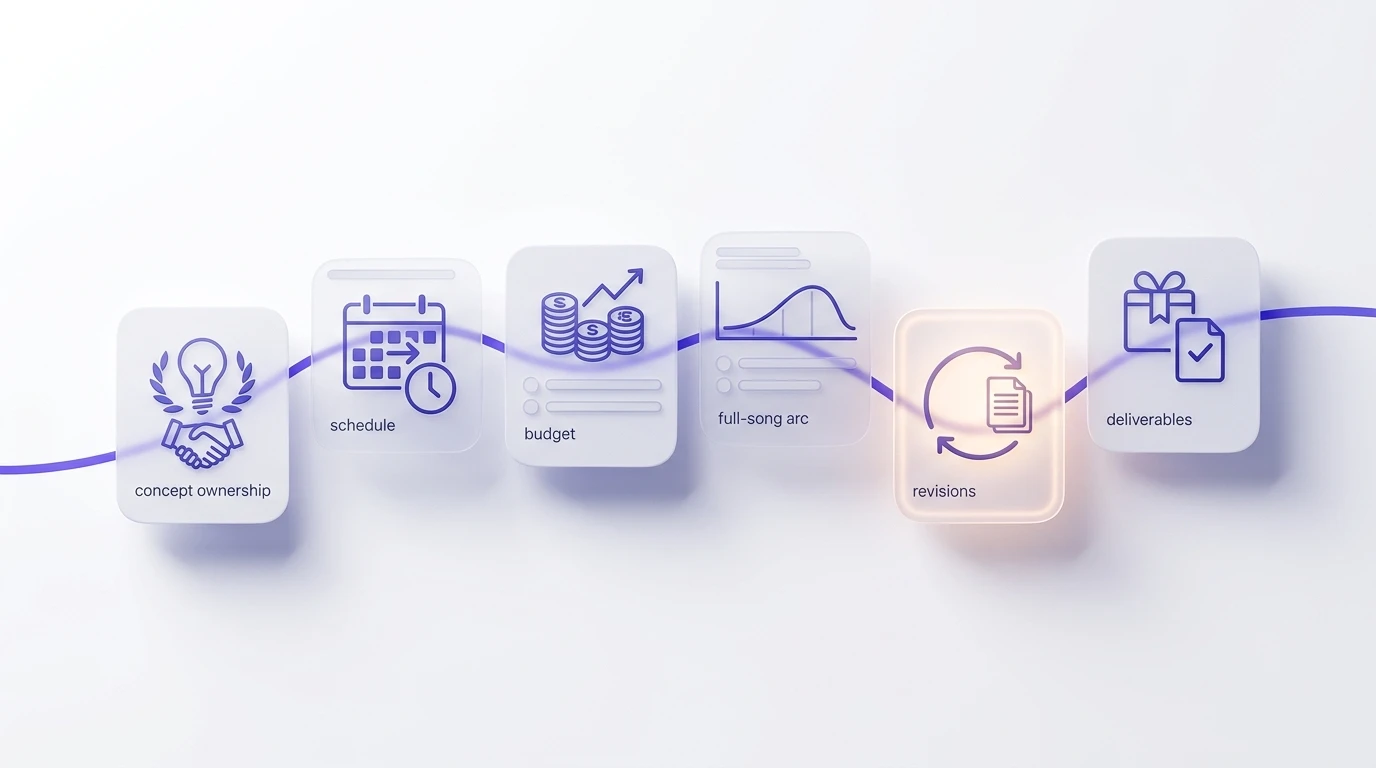
jenna ortega ai filmmaking should begin as a reference-deconstruction task. Define the mood, movement, character energy, and editing rhythm you want. Then price the production, verify likeness and source rights, and turn those choices into a workable brief. At SongTrailer, one creative director controls that process from concept through final edit.
- Translate a celebrity reference into specific creative attributes such as lighting, framing, movement, wardrobe mood, and pacing.
- Do not generate a recognizable celebrity for commercial release without documented permission covering likeness, synthetic media, territory, platforms, and duration.
- Lock source files, music rights, aspect ratios, revision scope, and disclosure requirements before image-to-video production begins.
- Budget around shot complexity and consistency. A longer video with one controlled visual world can cost less than a short sequence filled with characters and location changes.
What “jenna ortega ai filmmaking” should mean in a brief
A useful Jenna Ortega reference identifies creative qualities, not a person to reproduce. The reference might point toward deadpan performance, gothic styling, controlled body language, stark production design, or a particular mix of elegance and unease.
Write those qualities down separately. “Make it look like Jenna Ortega” gives a director no safe boundary and gives an image model too much room to create a recognizable likeness. “A self-possessed fictional lead in severe formalwear, moving through symmetrical interiors with restrained expressions” is specific enough to develop while keeping the character original.
The same method applies to established music-video references. If the inspiration is the Michael Jackson Smooth Criminal music video, isolate the long shadows, architectural staging, ensemble movement, and rhythmic cutting. Replicating Michael Jackson, the costume, or a recognizable sequence creates a different rights question.
Use a reference matrix before writing prompts:
| Reference element | Document this | Avoid requesting |
|---|---|---|
| Mood | Tense, playful, romantic, detached | “Exactly like her performance” |
| Character | Age range, attitude, silhouette, fictional biography | A recognizable celebrity face |
| Camera | Locked frame, slow push, handheld drift, overhead view | A copied shot with matching set and costume |
| Motion | Restrained gestures, sharp turns, continuous walking | Signature choreography recreated beat for beat |
| Design | Palette, texture, era, architectural influence | Distinctive protected character styling |
| Edit | Cut density, transition logic, performance coverage | A scene-by-scene remake |
This distinction also improves the final film. Models respond more consistently when the creative direction describes visible decisions rather than a celebrity name carrying dozens of conflicting associations.
Music and video production costs at each level
Music and video production costs depend on how many visual problems the concept asks production to solve. Runtime matters, but character continuity, scene changes, lip synchronization, complex motion, rights clearance, and social adaptations often drive more work than duration alone.
| Production level | Cost structure | Best fit | Main constraint |
|---|---|---|---|
| DIY AI test | Software subscriptions plus the artist’s production and editing time | Mood tests, visualizers, early concept proof | Continuity and rights review sit with the artist |
| Directed AI-assisted video | Fixed package or defined project fee | Full-song releases needing coherent direction | Requires a locked treatment and usable source assets |
| Traditional or hybrid shoot | Crew, cast, equipment, locations, post-production, insurance, and permits | Physical performance or location-led concepts | More variables can change the final quote |
| Licensed digital likeness production | Production plus talent permission, legal review, and possible specialist VFX | Authorized campaigns involving a real person | Rights can control whether the concept proceeds at all |
SongTrailer’s published AI music video package for artists is $3,500, with a full-song master and social-ratio adaptation delivered in about 5-7 business days after intake and direction lock. One creative director owns concept, pacing, and delivery through the final edit.
Compare quotes by deliverable and responsibility, rather than headline price. A useful scope states who develops the treatment, who supplies licensed source material, how character continuity is handled, which ratios are delivered, and what counts as a revision. Our guide to choosing a video production company explains the questions that expose vague scopes before they become change orders.
Rights checks for jenna ortega ai filmmaking references
Jenna Ortega AI filmmaking references raise four separate clearance issues: likeness, source material, music, and distribution use. A model accepting a prompt does not grant permission to publish its output.
Celebrity likeness can involve state publicity and privacy laws, contractual controls, false endorsement concerns, and platform rules. The US Copyright Office’s digital replicas report describes digital replicas as realistic synthetic representations of an individual’s voice or appearance and recommends federal protection against unauthorized replicas.
For a commercial music video, written permission should identify the approved depiction, media, territory, term, edit rights, promotional use, and synthetic modifications. A casual social post, press photograph, film still, or fan account upload is not evidence of commercial permission.
Source rights require the same discipline. Save the origin and license for reference frames, fonts, textures, stock elements, model assets, and generated material. Style can be discussed in broad visual terms, but copying protectable composition, character design, or expressive scene details can create infringement risk. A safely written treatment draws from several references and records the production logic behind the new work.
Music clearance has two layers. The composition and the sound recording are distinct works, as explained in the US Copyright Office’s guidance on copyright registration for sound recordings. An artist may control the master while a publisher, co-writer, producer, label, or sample owner controls another required permission. Confirm both before the edit is built around the finished track.
How to turn the reference into a production-ready brief
A production-ready brief replaces adjectives with decisions. “Cinematic and dark” is incomplete. The director still needs to know whose story is being told, how the camera behaves, what changes between verses, and which visual event earns the final chorus.
Start with a one-sentence premise. Then define the fictional lead, visual rules, performance approach, environments, and progression across the song. The treatment should make continuity visible on paper before any frames are generated. Our breakdown of music videography from treatment to final master shows how those decisions move through production.
| Brief field | Production-ready answer |
|---|---|
| Creative objective | What the audience should feel and remember |
| Original character | Appearance boundaries, attitude, wardrobe logic, prohibited likenesses |
| Visual world | Era, palette, texture, weather, architecture, practical or synthetic feel |
| Song structure | Intro, verse, chorus, bridge, instrumental, outro |
| Motion language | Camera movement, subject movement, transition behavior |
| Reference use | The specific quality taken from each source |
| Deliverables | Primary master, vertical or square adaptation, captions if required |
| Rights record | Music ownership, source licenses, releases, model terms |
| Approval point | Who locks direction before full production starts |
| Revision scope | Which changes are refinements and which require regenerated scenes |
Build the shot list around musical function. A verse may hold longer on one environment, while a chorus needs stronger scale or movement. Repeating a visual motif can create continuity without repeating footage. This is where human direction earns its place: generated clips become a film only after someone controls selection, pacing, visual causality, and the relationship between picture and song.
Videographer music videos or AI-assisted direction?
Videographer music videos capture a physical performance, location, or event through a camera crew. AI-assisted music videos construct some or all of the visual material through generative systems, then rely on direction, compositing, sound synchronization, and editing to create continuity.
Choose videography when the artist’s physical presence carries the concept. Live choreography, band chemistry, documentary texture, and a meaningful location usually benefit from production in front of a lens. Choose AI-assisted direction when the concept calls for environments, transformations, period worlds, or visual scale that a conventional shoot cannot reach within the schedule.
A hybrid can use filmed performance as the continuity anchor and synthetic imagery for world-building. That approach still needs clean ownership of the footage, performer releases, and explicit agreement about how filmed faces or bodies may be transformed.
Whichever route you choose, ask for a full-song timeline test before polishing isolated hero shots. Beautiful fragments can hide weak pacing. A full assembly reveals whether the visual idea survives every verse, instrumental passage, and repeated chorus.
Editing, ratios, revisions, and platform disclosure
Human-directed editing controls whether image-to-video material feels intentional. The editor must manage eyelines, motion direction, color continuity, temporal jumps, repeated anatomy errors, and the precise frame where each musical transition lands.
Approve changes in layers. Lock the treatment first, then character and environment direction, followed by the rough full-song sequence. Late requests to replace the lead, alter the visual era, or rebuild the chorus change the production premise rather than refining the edit. The revision scope should say so plainly.
Social adaptation also needs creative judgment. Cropping a widescreen master can remove faces, gestures, titles, or the subject of a two-person composition. A proper vertical adaptation reframes shots individually and may use alternate takes or layouts to protect the focal point.
Platform disclosure should be decided before upload. YouTube requires disclosure when realistic content is meaningfully altered or synthetically generated in a way viewers could mistake for reality, according to its altered or synthetic content policy. Record which scenes include synthetic people, voices, events, or locations so the release team can label the upload accurately.
Frequently Asked Questions
What is the difference between videography and video production?
Videography usually refers to capturing footage with a camera. Video production covers the broader process, including concept development, rights, casting, generation or filming, editing, sound synchronization, mastering, and delivery.
What is the best tool for AI video editing?
The best tool depends on the bottleneck. Generative tools create or animate shots, while a timeline editor such as Adobe Premiere Pro, DaVinci Resolve, or Final Cut Pro handles pacing, sound, compositing, color, and final masters. A professional workflow often uses several tools under one locked creative direction.
What do most YouTubers use to edit music videos?
Common choices include Premiere Pro, Final Cut Pro, and DaVinci Resolve. Tool choice matters less than timeline control, source organization, export settings, and the ability to revise individual shots without damaging synchronization.
Can AI legally recreate a celebrity for a music video?
Commercial use of a recognizable celebrity replica can trigger likeness, publicity, false endorsement, copyright, contractual, and platform issues. Obtain qualified legal advice and documented permission before using a real person’s recognizable face, voice, or performance characteristics.
A strong reference brief describes mood and motion without requesting an unauthorized replica of a real person. Document the desired character, source rights, song ownership, shot logic, delivery formats, and disclosure plan. If you have a finished track and need to turn that document into a directed full-song video, get in touch with SongTrailer to discuss the creative direction.