
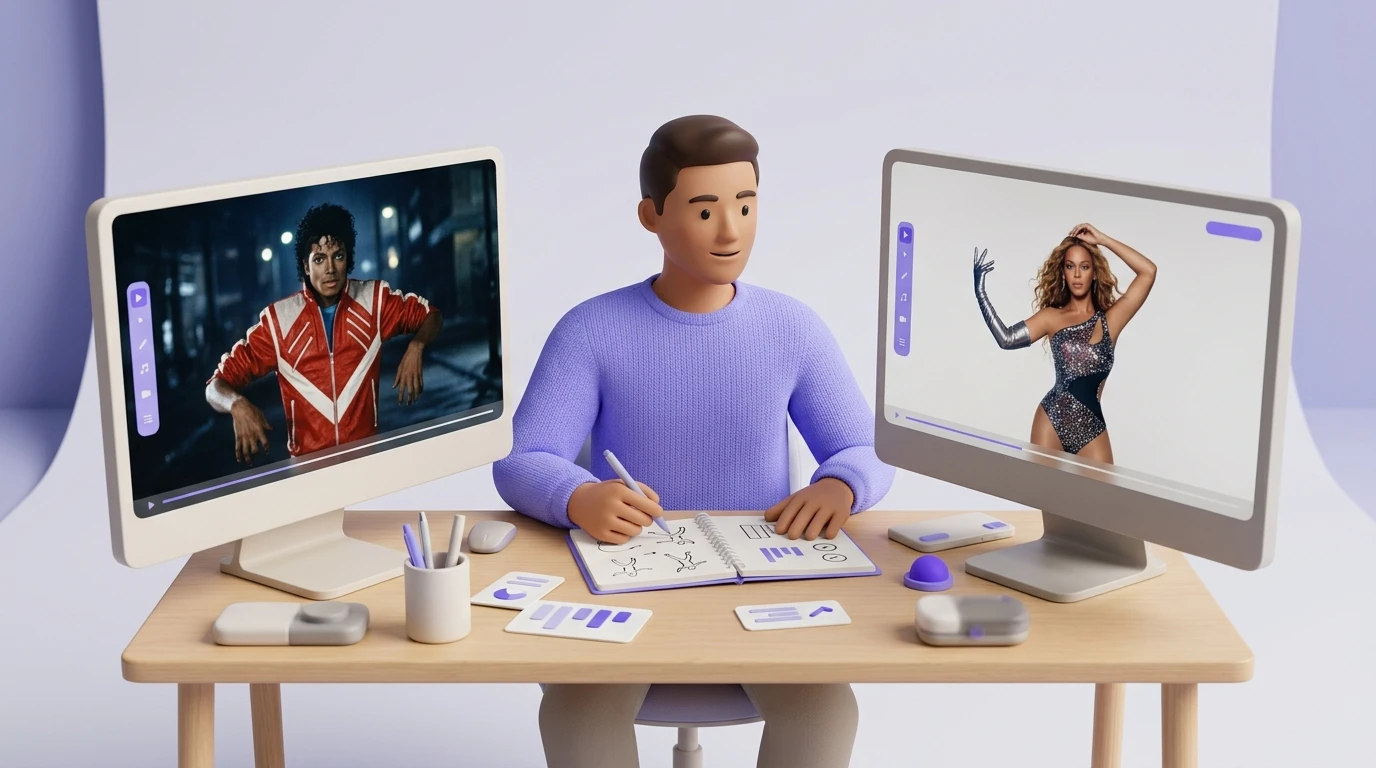
The greatest music videos of all time include “Thriller,” “Take On Me,” “Sledgehammer,” and “Formation” because each gives its song a lasting visual identity. John Landis made Michael Jackson’s “Thriller” a short-film event. Our comparison separates creative achievement from influence, then shows which techniques survive an independent artist’s budget.
- Judge creative execution and historical influence separately. A landmark video can still be a poor production reference for your song.
- Borrow a governing visual rule, such as the drawn world in “Take On Me,” rather than copying an iconic costume or shot.
- Map the entire song before production. Repeated choruses need visual development, even when the location and performer stay the same.
What criteria make a music video historically great?
A historically great music video changes how a song is experienced and gives later filmmakers something worth developing. Its images feel connected to the artist. Its formal choices remain legible after the novelty fades.
Cultural impact and visual quality are different judgments. The Library of Congress includes “Thriller” in its National Film Registry, establishing its preservation significance. That recognition does not make its extended short-film structure the right choice for every release.
I judge creative quality through concept, artist identity, craft, and song pacing. Concept asks whether a clear idea holds the piece together. Identity asks whether the images belong to this performer, rather than any artist with access to the same production.
Craft includes cinematography, production design, choreography, and editing. Those choices must cooperate: a beautifully lit room contributes little if the camera hides the movement or the edit cuts away before a gesture lands. Pacing asks how that visual system develops across the full song.
Narrative clarity does not require a conventional plot. “Sledgehammer” remains readable because its transformations follow a consistent playful logic, while “This Is America” creates tension between foreground performance and background violence.
Historical context matters, too. Among 1970s music videos, Queen’s “Bohemian Rhapsody” established a durable identity through shadowed faces and performance imagery. The eighties music videos that followed expanded the possibilities of animation and cinematic storytelling.
Comparing the greatest music videos of all time
The table separates creative achievement from influence. Budget, awards, and view counts receive no score. There is no combined total because adding influence to craft would obscure the distinction we are trying to make.
The scores below are SongTrailer’s subjective editorial judgments on a five-point scale: 5 means defining strength, 4 means strong execution, and 3 means effective work with a meaningful limitation or format trade-off. “Pacing” evaluates how well the visual structure serves a full-song viewing experience.
| Video | Concept | Artist identity | Craft | Pacing | Influence |
|---|---|---|---|---|---|
| Michael Jackson, “Thriller” | 5 | 5 | 5 | 3 | 5 |
| a-ha, “Take On Me” | 5 | 3 | 5 | 4 | 5 |
| Peter Gabriel, “Sledgehammer” | 5 | 5 | 5 | 5 | 5 |
| Madonna, “Like a Prayer” | 4 | 5 | 4 | 4 | 5 |
| Missy Elliott, “The Rain (Supa Dupa Fly)” | 5 | 5 | 5 | 4 | 4 |
| Johnny Cash, “Hurt” | 4 | 5 | 5 | 5 | 4 |
| OK Go, “Here It Goes Again” | 5 | 4 | 4 | 4 | 4 |
| Beyoncé, “Single Ladies (Put a Ring on It)” | 4 | 5 | 5 | 5 | 5 |
| Beyoncé, “Formation” | 5 | 5 | 5 | 5 | 5 |
| Childish Gambino, “This Is America” | 5 | 5 | 5 | 5 | 5 |
These scores expose trade-offs. “Thriller” earns its stature through the complete film, including material outside the song; its extended setup makes it less direct as a full-song release template. “Take On Me” has an exceptionally strong visual concept, but that concept could transfer to another romantic pop act more easily than “Hurt” could transfer to another singer.
Concept and artist identity
Melina Matsoukas’s “Formation” connects Beyoncé’s performance to Black Southern identity through specific settings and imagery. The flooded streets and plantation-house tableaux give the song a cultural world. Remove that context and much of the video’s force disappears.
Mary Lambert’s “Like a Prayer” makes religious imagery central to Madonna’s provocative public identity. Mark Romanek takes a quieter route in “Hurt”: close views of Cash, archival footage, and images of decay make the song feel inseparable from the person singing it. Specificity carries more weight than visual expense.
Performance and editing rhythm
Jake Nava’s “Single Ladies” builds almost everything around movement. The restricted setting keeps attention on the dancers, while reframing and concealed transitions sustain energy. Its apparent simplicity requires exceptional performance and precise camera coordination.
Hiro Murai’s “This Is America” uses choreography differently. Dancing draws attention while disturbances accumulate elsewhere in the frame. The viewer’s shifting focus becomes part of the meaning, giving repeat viewing a purpose beyond admiring technique.
Craft and directorial authorship
Steve Barron’s official “Take On Me” video makes the boundary between live action and pencil animation part of the story. Rotoscoping, which draws over filmed movement, provides continuity between the worlds. The technique serves an emotional idea: crossing into someone else’s reality.
Stephen R. Johnson’s “Sledgehammer” uses stop-motion animation and practical transformations to give Gabriel a mischievous, elastic screen identity. For artists studying the best rap music videos, Hype Williams’s “The Rain (Supa Dupa Fly)” offers a related lesson. Wide-angle distortion and sculptural wardrobe amplify Missy Elliott’s personality.
Directorial authorship matters when it gives the song a coherent visual language. A recognizable camera trick alone is a thinner achievement.
How do narrative, choreography, animation, and spectacle compare?

Each approach holds attention differently. The useful choice depends on what the song needs from its images and what the production can execute consistently.
| Approach | What holds attention | Strong reference | Main production demand | Common failure |
|---|---|---|---|---|
| Narrative or short film | A situation changes | “Thriller” | Story coverage and clear stakes | Dialogue or setup overwhelms the song |
| Choreography | Movement develops with the music | “Single Ladies” | Rehearsal and camera blocking | Repeated movement loses impact |
| Experimental animation | A visual rule produces new variations | “Sledgehammer” | Consistent design and controlled motion | Effects feel unrelated to the track |
| One-take performance | Anticipation and visible coordination | “Here It Goes Again” | Rehearsal and precise timing | The opening idea cannot sustain the duration |
| Spectacle | Scale or transformation | “Formation” | Production design and visual hierarchy | Expensive images have little connection to the artist |
Trish Sie and OK Go’s “Here It Goes Again” treadmill routine works because the viewer can understand the challenge and watch it unfold. A one-take video needs internal progression. Camera movement alone rarely provides enough.
Practical effects can create a similarly readable challenge. A physical transformation gives performers something to react to and the viewer something to believe. Its value comes from the relationship between effect and song, not from using an older technique.
Choose the approach that can sustain your track’s duration. A striking opening image is only the start. The second verse needs a reason to exist visually, and the final chorus should feel changed by what preceded it.
Which celebrated videos are poor templates for independent artists?
A great reference becomes a poor template when its effect depends on resources, context, or performance ability that your production cannot reproduce.
“Thriller” and Michael Jackson’s “Smooth Criminal” demand coordinated ensembles, extensive rehearsal, and substantial production design. Borrowing their surface styling without that underlying preparation usually leaves the frame feeling underpopulated. The portable lesson is how movement organizes space.
“Formation” also needs careful handling. Its imagery carries cultural meaning that a generic mood board cannot reproduce. Borrow its commitment to artist-specific context; develop images grounded in your own song and identity.
“Single Ladies” looks economical, but its performance demands are severe. An empty studio exposes weak movement. It offers little visual cover when the choreography or camera placement falls short.
“Sledgehammer” presents a different risk. Constant transformation creates a heavy execution burden, especially when a release date is approaching and there is limited time to repair inconsistent shots. A smaller family of recurring effects can preserve the idea while reducing production uncertainty.
When comparing production partners, our guide to choosing a video production company can help you evaluate the proposal beyond its reference reel. Ask what must be rehearsed, what requires testing, and which parts of the concept would change if the schedule tightened.
How can you apply these lessons to a finished track?
Start with the song’s emotional change, then choose a visual rule that can carry it. A treatment is the written plan connecting that rule to the full edit; our music videography guide from treatment to final master explains that production sequence in more detail.
Consider a hypothetical breakup single that moves from numbness toward resolve. The budget allows a performer and a single room. Here is a workable process.
-
Map the song before choosing shots. Mark the opening, verses, choruses, and ending. Write the emotional state beside each section: withdrawn in the opening, unsettled through the middle, decisive at the end.
-
Define one governing image. Use a locked door inside an otherwise ordinary room. The performer’s changing relationship to that door gives the song a visible structure without requiring additional locations.
-
Build progression across the full track. In the opening, keep the door outside the performer’s eyeline. During the first chorus, reveal it clearly. Let the next verse move closer, then reserve touching or opening it for the final chorus. Repeated music receives a changed image.
-
Test continuity and delivery before production. Check the door’s position, wardrobe, lighting direction, and performer placement across the planned shots. For AI music videos for artists, those details need explicit direction and shot-by-shot review. Check both the primary master and social crop so the door remains legible in each ratio.
The example has a complete arc. It also provides a practical basis for rejecting shots: an attractive image that does nothing for the performer’s relationship to the door probably belongs in another video.
Plan the full-song master first. A social adaptation can draw from that structure, but a collection of isolated teaser moments leaves the finished track without a complete visual experience.
Frequently Asked Questions
What is considered the greatest music video of all time? “Thriller” is a strong choice because it combines cinematic storytelling with an enduring performance identity. There is no universal winner: “Sledgehammer,” “Take On Me,” and “Formation” make compelling cases through different creative strengths.
What are the 100 greatest music videos of all time? There is no official universal list. Rolling Stone’s published selection, documented in its 100 greatest music videos list, places “Formation” first; treat that as an editorial judgment rather than a settled measurement.
What are some of the greatest music videos ever shown on MTV? “Billie Jean,” “Thriller,” “Take On Me,” “Sledgehammer,” “Like a Prayer,” and “Smells Like Teen Spirit” are strong starting points. Watch how each establishes the artist’s identity through movement, setting, or a distinctive visual treatment.
Are the most-viewed music videos also the best? View counts measure audience activity, not cinematography or conceptual strength. Distribution and the song’s popularity can expand reach, so evaluate visual quality separately from popularity.
Choose a reference for the idea you can develop into your own treatment. SongTrailer pairs human creative direction with AI-assisted visuals for full-song music videos. If you have a finished release to discuss, get in touch with SongTrailer with the track and a reference whose underlying idea fits your song.