
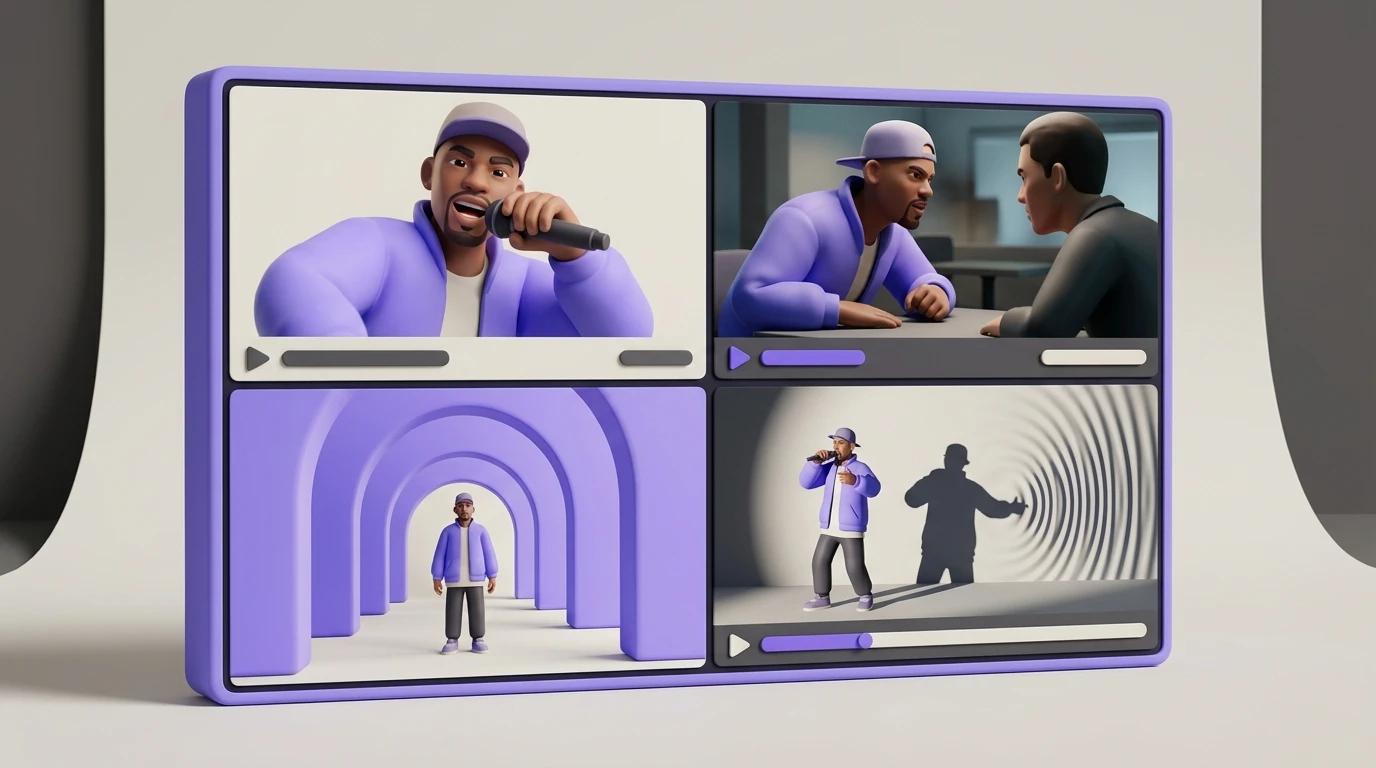
The best rapper music videos make the artist memorable and give the full song a visual arc. For a release team, the right choice depends on presence, continuity, and production demands. At SongTrailer, one creative director owns concept through final edit. This comparison helps you choose a format your track can sustain.
- Judge a reference across the full song. A strong opening means little if the second verse repeats the same visual idea.
- Choose a concept you can keep consistent. Locations, wardrobe, and recurring imagery need to belong to the same visual world.
- Plan social framing before production. A wide group shot or intricate effects sequence may lose its meaning in a vertical crop.
Which criteria define the best rapper music videos?
A strong rap video gives the viewer a reason to remember both the record and the artist. We judge it by what survives after the spectacle: a face, a feeling, a scene worth watching again.
Artist presence measures how clearly the rapper’s identity comes through. Hook strength means the visual idea that catches attention and returns with purpose, especially around the chorus. Originality comes from a distinctive interpretation of the song, rather than borrowed wardrobe or recognizable scenes from another artist’s video.
Continuity matters across the full runtime. Does the setting follow its own rules? Do changes in lighting, costume, or visual style feel deliberate? Replay value comes from details and emotional turns that reward another watch.
The commissioning criteria are equally practical. Production complexity includes cast, locations, effects, and the difficulty of fixing a shot after approval. Social adaptability asks whether the central idea still reads when the frame becomes narrow.
Choose the strongest idea you can sustain through the final chorus. That is a more useful test than whether a reference looks expensive.
How do performance, narrative, conceptual, and effects-led formats compare?
Performance centers the artist. Narrative centers events. Conceptual videos organize the song around a visual idea, while effects-led videos use image transformation as a major attraction. Most finished videos combine these approaches, but one should lead.
The scores below are our commissioning judgments, not audience-performance data. High, medium, and low describe typical strengths or demands. “Continuity control” means how easily the visual world can stay coherent; high production complexity means more moving parts.
| Format | Artist presence | Hook strength | Originality potential | Continuity control | Production complexity | Social adaptability | Replay potential |
|---|---|---|---|---|---|---|---|
| Performance-led | High | Medium | Medium | High | Low to medium | High | Medium |
| Narrative-led | Medium | High | High | Medium | High | Medium | High |
| Conceptual | Medium to high | High | High | Medium | Medium to high | Medium | High |
| Effects-led | Variable | High | High | Low to medium | High | Medium | High |
A simpler format can still require an expensive shoot. A tightly controlled concept can be economical. Scope determines the bill.
Performance-led: the artist carries the frame. Direct-to-camera delivery makes expression and timing the main event. Crew scenes can establish belonging, while practical locations give the record a physical setting without requiring elaborate sets.
Wu-Tang Clan’s official “C.R.E.A.M.” video uses neighborhood imagery and group presence to ground the record. The commissioning lesson is specificity: a meaningful location can do more for identity than an anonymous luxury backdrop. Performance weakens when every setup uses the same distance, gesture, and energy.
Narrative-led: the song gains a dramatic arc. Eminem’s official “Stan” video builds its story around the fan whose letters drive the lyrics. Its power comes from the relationship between the song’s structure and the unfolding events.
Choose narrative when the record contains characters, consequences, or a clear emotional change. Expect more dependencies around casting and coverage, meaning the different shots needed to make a scene understandable. The rapper may also spend less time at the center of the frame.
Conceptual: a visual rule holds the world together. Busta Rhymes’ “Put Your Hands Where My Eyes Could See” combines stylized production design with choreography and heightened performance. Its world feels deliberate because movement and setting share the same exaggerated character.
The transferable lesson is commitment to a visual language. A recurring gesture or location can unify a concept. Copying another artist’s costumes or signature imagery gives your release someone else’s identity.
Effects-led: transformation becomes part of the performance. Kendrick Lamar’s official “HUMBLE.” video combines performance with striking tableaux, optical distortion, and composited imagery. Its strongest moments remain easy to read despite the visual invention.
Effects can expand a visual world beyond what a practical shoot can build. They also introduce failure points. Changing faces, unstable clothing, or inconsistent environments can break continuity, particularly when AI-assisted imagery lacks firm direction and a human edit.
Which style suits different tracks, budgets, and artist personas?
Choose the format according to the job the single needs to do. An introduction to a new rapper usually benefits from clear artist presence. A release from an established persona has more room to let a story or visual concept take the lead.
Choose performance if the delivery is the selling point. Drill can benefit from controlled crew scenes and assertive camera movement when the record’s energy supports them. Boom bap can work well with practical locations and patient shots that leave room for the verse. Neither requires a prescribed color palette or street-video formula.
Trap often gives a director space to build atmosphere through lighting and production design. A repeated camera move can become the visual equivalent of a recurring beat pattern. Avoid adding movement to every shot; contrast makes the chorus land harder.
Choose narrative if the song changes emotionally. A confession, betrayal, or comeback gives the editor something to develop across verses. Skip an elaborate plot when viewers need to hear the lyrics to understand every action. The images should remain legible on their own.
Choose conceptual if the artist’s persona can support a distinct visual world. Alternative rap often leaves room for surreal environments or unexpected choreography. Movement needs a reason, though. A restrained rapper can feel more convincing in a carefully designed static frame than in forced dance coverage.
Choose effects-led work when transformation expresses the record’s mood. If the song feels claustrophobic, a room that slowly changes can carry meaning. Unrelated spectacular scenes may offer a strong teaser while leaving the full song visually disconnected.
Budget should follow the approved concept. SongTrailer’s AI-assisted full-song music video package for artists costs $3,500 flat and includes a primary master plus a social-ratio adaptation. SongTrailer’s stated delivery window is about 5–7 business days after intake and direction lock, so the release schedule must leave room for those prerequisites.
When should you avoid each approach?
Avoid a format when its main demand conflicts with the artist or the production conditions. A reference can be excellent and still be wrong for your release.
Skip a performance-heavy treatment if the artist is uncomfortable on camera and there is no time to prepare. Rehearsal can help. More camera movement will rarely fix uncertain delivery.
Avoid a complex narrative when the release date is close and casting or locations remain unresolved. Missing one essential scene can leave the story incomplete. A self-contained concept usually offers more flexibility than a plot built around several interdependent events.
Skip choreography when it clashes with the persona or cannot be rehearsed. Crew scenes carry their own risk: everyone affects the frame, even when they are standing still. Unfocused background behavior makes a serious record feel casual.
Avoid effects-led production if the team cannot explain how it will preserve character identity and handle revisions. When comparing suppliers, our guide to choosing a video production company provides a framework for the decision. Ask who owns the final edit and what happens when an approved scene needs rebuilding.
Color grading should support the footage. Heavy contrast cannot rescue unclear blocking, and a fashionable tint will not connect scenes that belong to different visual worlds.
How do you turn a reference into a full-song release plan?
A usable brief translates admiration into production decisions. “Make it cinematic” gives a director little to approve. “Keep the artist isolated in a recurring room that changes with each chorus” establishes a workable visual rule.
A treatment is the written creative plan for the video. Our guide to music videography from treatment to final master follows that production path. Build the brief in this order:
- Identify what the reference does. Describe its framing, movement, and relationship to the song. Separate those choices from the original artist’s recognizable imagery.
- Map the finished track. Mark verses, choruses, and transitions. Assign each section a visual purpose so the middle of the song develops rather than stalls.
- Lock the visual rules. Approve the artist’s appearance, locations, and recurring motifs before creating the full sequence. Define which changes are intentional.
- Approve delivery requirements. Confirm the primary master, social adaptation, refinement rounds, and delivery date. Record file ownership and usage terms in the agreement.
Rhythmic editing should follow musical phrasing. Cutting on every beat removes contrast; holding through a line can give the next cut more force. Save a meaningful change for a lyrical turn or returning chorus.
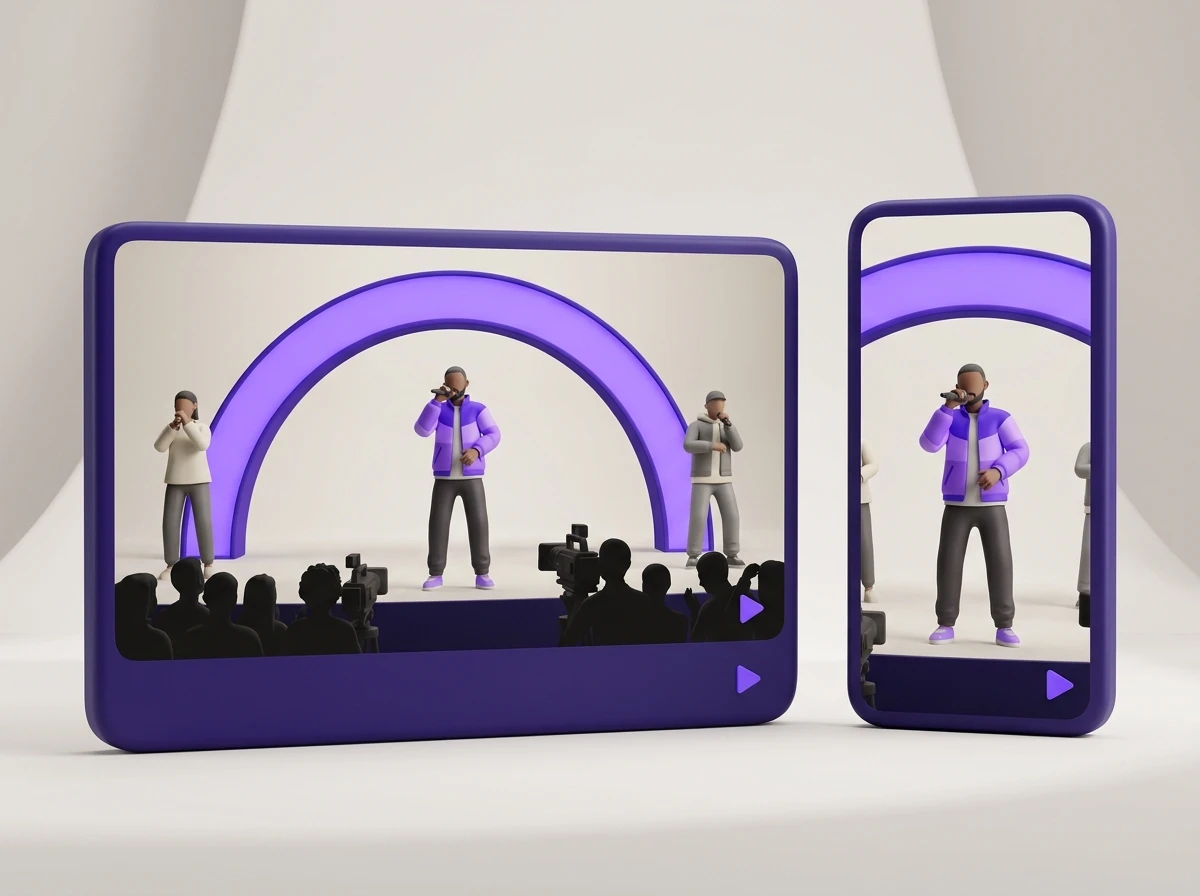
Vertical music videos need deliberate composition. Faces and essential action should remain readable when the frame narrows. YouTube’s video resolution and aspect-ratio guidance identifies 16:9 as its standard desktop ratio and explains how the player adapts to other shapes.
Treat the social version as an adaptation, not an automatic crop. A wide crew scene may need alternate framing, while an effects shot may need repositioning to preserve its central action. Approve the full-song master before selecting excerpts so the release clips represent a coherent finished video.
Frequently Asked Questions
What are some of the best rap music videos of all time? “Stan,” “C.R.E.A.M.,” “Put Your Hands Where My Eyes Could See,” and “HUMBLE.” are useful references for different reasons. They demonstrate narrative, artist identity, conceptual world-building, and effects-led visual impact rather than a single winning formula.
Who has the best music videos in rap? There is no objective winner. Kendrick Lamar is a strong reference for visual concepts, Busta Rhymes for stylized performance, and Eminem for narrative storytelling.
Which rap video style works best on a limited budget? A focused performance video in a controlled location is often easier to scope than a cast-heavy narrative. Spending carefully on lighting and artist preparation can produce a more convincing result than spreading the budget across several weak setups.
Are the most-viewed rap videos the best creative references? View counts reflect audience reach as well as the video itself. Choose references for decisions you can apply to your release, such as artist framing or full-song pacing, rather than assuming popularity proves creative fit.
Choose a visual approach that gives your artist a clear identity and carries the finished track from opening to final frame. If you have a single ready for a human-directed, AI-assisted full-song video, get in touch with SongTrailer with the track and intended release date. Bring the reference that fits your record, and name the creative choice you want to take from it.