1970 music videos include promotional films, television performances, and concert footage, but those categories need separate labels. Pink Floyd’s official release credits for The Early Years date their KQED session to 30 April 1970. Use the examples and archive-checking steps below to distinguish period footage from older material released that year and later re-edits.
- Separate recording, broadcast, and release dates. A film released in 1970 may contain performances recorded earlier.
- Identify the clip’s original purpose before calling it a promotional video. A television appearance and a standalone promo can look remarkably similar.
- Treat an upload’s “HD,” “remastered,” or “official” label as information about that edition. Verify the underlying footage separately.
- Preserve the original framing when studying a clip. Cropping and replacement audio can hide evidence about its production.
What qualifies as a music video from 1970?
A strict definition includes a short film made to promote a particular recording. A broader historical definition also includes televised songs and filmed performances that circulated as individual clips. Both are useful, provided you identify which category you mean.
The terminology was unsettled. Producers might call the material a promotional film, film insert, or performance. Applying the later MTV model to everything obscures how the footage was commissioned and distributed.
Keep the year attached to a specific event. “Recorded in 1970” makes a different claim from “broadcast in 1970.”
These examples provide useful starting points:
| Material to find | Source-supported date | How to classify it |
|---|---|---|
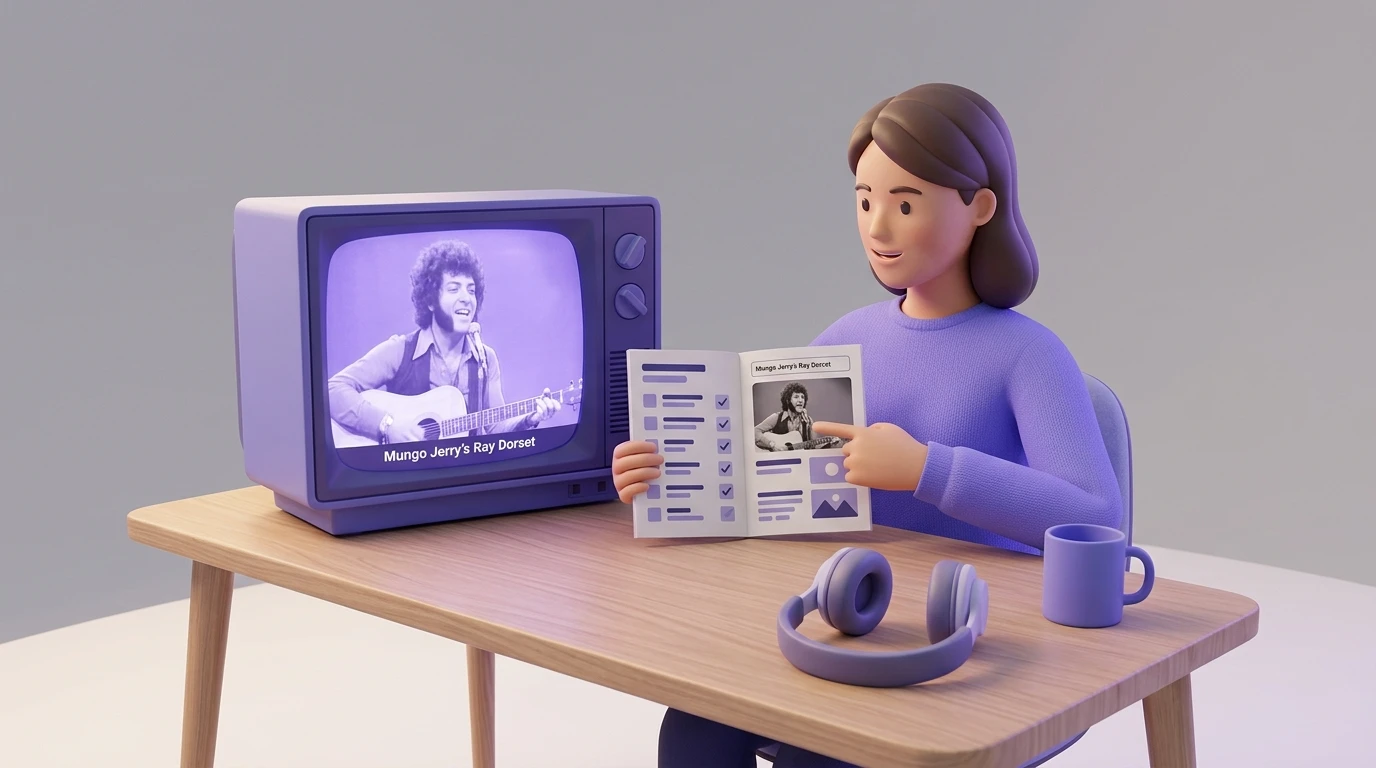
| Mungo Jerry, “In the Summertime,” original promotional clip | The artist’s “Original 1970” presentation of the clip identifies it as 1970 material. It does not establish an exact shooting day. | A standalone promotional performance. Retain the year attribution without inventing a more precise date. |
| Pink Floyd, An Hour with Pink Floyd, KQED session | Pink Floyd’s The Early Years release credits give 30 April 1970 for the KQED material. | Television studio performance footage. Search the programme title as well as individual songs. |
| Top of the Pops, Christmas edition | The BBC programme archive’s Christmas 1970 listings document the broadcast on 25 December 1970. | A broadcast-date reference. Match a circulating excerpt to the episode before assigning that date to it. |
| The Beatles, Let It Be | The Beatles’ official account of the film identifies January 1969 filming and a May 1970 cinema release. | A 1970 film release containing earlier performances. It should not be described as footage shot in 1970. |
The BBC listing establishes that a programme was scheduled. It does not prove that every circulating clip came from that edition, or that the complete broadcast survives.
These distinctions also matter when exploring wider 1970s music videos. A decade playlist can mix genuine promos with concert extracts and television appearances without telling you which is which.
Where were these clips originally shown?
The main outlets were music television programmes and cinemas. Record labels supplied promotional material to broadcasters, while concert films and artist documentaries reached viewers through theatrical exhibition.
A promotional film let an artist appear on television without attending the studio. It also gave the label a repeatable visual asset tied to a recording. The receiving broadcaster could introduce it, shorten it, or place it inside a programme with other acts.
Television performances followed different rules. A programme’s set, cameras, and running order shaped the presentation. An artist might sing live, mime to the released record, or perform with a mixture of live and prerecorded sound.
Cinema supplied another route. Concert films preserved an event; artist films could combine performances with rehearsal footage or dramatic scenes. A song extracted from either can resemble a standalone video once its surrounding material disappears.
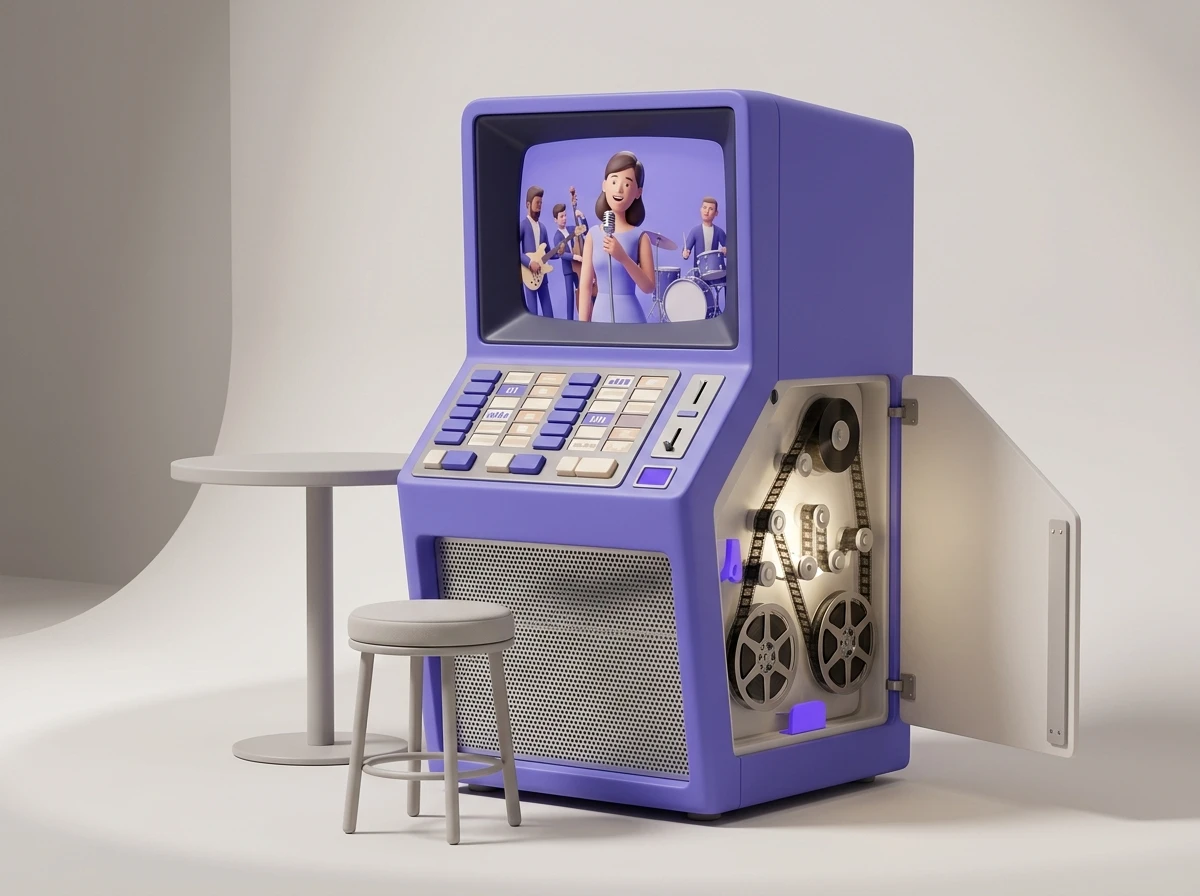
Scopitones belonged to a separate viewing system. These coin-operated film jukeboxes played short musical films on 16mm. Their catalogue is part of music-film history, but a Scopitone placed in a seventies playlist still needs its own production date.
The original outlet explains much of what you see. A studio backdrop may reflect a broadcaster’s house style. A long instrumental passage may survive because the footage came from a concert film rather than a short promotional slot.
How can performance footage and promotional films be distinguished?
Classify the clip along two separate axes: why it was made and how the performance was recorded. “Promotional” describes purpose. “Live” or “mimed” describes the relationship between the image and sound.
A promo can show a mimed performance. A television appearance can use live sound. A label can later repurpose concert footage for promotion without changing its original production context.
| Evidence in the clip | What it suggests | What it cannot prove alone |
|---|---|---|
| Presenter introduction, programme titles, or recognisable studio set | A television programme source | That the artist performed live |
| Audience reaction, stage announcements, or continuous concert coverage | An event recording | That the uploaded audio belongs to that performance |
| Location scenes and song-specific visual sequences | A standalone promotional treatment | Its production year |
| Lip movements closely matching the released recording | Playback or miming | Whether the footage was made for television or for a label |
| Film credits or rehearsal scenes surrounding the song | An extract from a larger artist or concert film | That the extracted song originally circulated independently |
Listen as carefully as you watch. Compare the phrasing with the released recording, then check whether audience sound continues naturally across edits. A perfect match can support a playback identification, but restoration may have replaced the original soundtrack.
Miming is a production method, not evidence of a fake historical clip. It allowed controlled camera coverage while keeping the familiar recording intact.
For filmmakers, this distinction belongs in the treatment. Our guide to music videography from treatment to final master explains that production chain; deciding how performance and soundtrack relate should happen before the edit.
How do you find and date an original clip?
Start with the artist, song, and likely outlet. Then establish the footage’s provenance: the documented chain connecting the circulating copy to its original production.
Use this sequence:
- Find the strongest available record. Search artist archives, broadcaster catalogues, film catalogues, and release booklets. Use the programme or film title alongside the song title.
- Record each date separately. Note filming or recording, first broadcast, original release, and the modern upload. Leave unknown fields blank.
- Match the actual footage. Compare costumes, sets, introductions, and surrounding shots with the documented version. A matching song title is insufficient.
- Check whether the edition has changed. Look for replacement audio, missing introductions, new titles, cropped framing, or a montage assembled from different sources.
- Write a qualified identification. State the strongest supported date and its source. If records disagree, preserve that disagreement instead of choosing the most convenient date.
A usable catalogue note might read:
Pink Floyd, KQED studio session. Recorded 30 April 1970 according to the band’s The Early Years release credits. Recording date established; the upload date does not establish the first broadcast date.
For a less certain clip, “Attributed to 1970 by the artist’s archive; exact filming date unconfirmed” is a sound conclusion. Precision must come from the record.
Missing archives complicate the work. Broadcasters did not preserve every programme, and surviving copies may be incomplete or several generations removed from the original. A catalogue entry can survive even when the footage does not. Conversely, footage may circulate after its original production paperwork has disappeared.
Search for early music videos by programme and production context, not only by artist. A broadcaster’s catalogue may index the episode rather than every song it contained.
Which production traits foreshadowed later music videos?
Song-specific staging, expressive lighting, and cuts shaped around musical phrases all anticipate later music-video practice. The useful connection is the relationship between sound and image, rather than a claim that every period clip followed the same format.
16mm film supported location shooting and portable production. It also introduced grain, physical splices, and the cost of processing. Analog video suited studio workflows, where camera switching and electronic effects could become part of the recorded programme.
Keep those acquisition formats separate. Film footage transferred to videotape can contain both film grain and tape defects. A soft online copy does not reveal which medium captured the original scene.
Psychedelic treatments used techniques such as coloured lighting, superimposition, optical distortion, and electronic feedback. Identify the visible effect before naming its mechanism. A glowing outline might come from processing or from a later transfer.
Editing provides a more dependable lesson. Watch where a close-up replaces a wide shot, whether a visual change follows a musical phrase, and how long an image holds through an instrumental section. A limited set can still sustain a full song when coverage and pacing have a plan.
That is useful for an artist with a finished track, an approaching release date, or a budget that cannot support an elaborate shoot. Borrow the visual discipline: a consistent setting, motivated changes in scale, and shots that remain usable throughout the song. Copying surface grain alone rarely solves visual continuity.
At SongTrailer, one creative director owns concept, pacing, and delivery for human-directed, AI-assisted full-song music videos. The historical lesson carries across production methods: continuity needs direction.
Framing matters too. ITU-R BT.470 specifies the conventional 4:3 television aspect ratio; cinema and film sources require their own checks. A widescreen upload may crop a television master, while a vertical adaptation can remove performers or scenery that explain a composition.
“Remastered” also needs interpretation. A new scan from surviving film can recover detail absent from an old transfer. An upscale of a tape copy cannot recover equivalent original image information, and aggressive noise reduction can erase texture.
Frequently Asked Questions
Did music videos exist in the 1970s? Yes. Promotional films and televised song performances existed before the familiar MTV-era format. Identify each clip’s original purpose rather than treating every musical moving image as the same kind of production.
What are some classic music clips from 1970? Start with Mungo Jerry’s original “In the Summertime” promotional clip and Pink Floyd’s KQED studio material. For television, investigate documented music-programme episodes and verify that an excerpt actually belongs to the broadcast being cited.
Does a song released in 1970 automatically have a music video from 1970? No. Its visual accompaniment might have been filmed later, assembled from earlier footage, or created for a modern reissue. The record’s release date cannot substitute for the clip’s production or broadcast date.
Does an HD remaster show how the original clip looked? It may preserve more detail, especially when made from surviving film elements. Check whether the edition also changes framing, colour, speed, or sound before using it as evidence of the original presentation.
Choose a clip and build a provenance note before adding it to a playlist or reference board. If you are turning that research into a finished-song visual, get in touch with SongTrailer with the track and reference footage. Specify what you want to carry forward: the framing, the performance treatment, or the pacing.