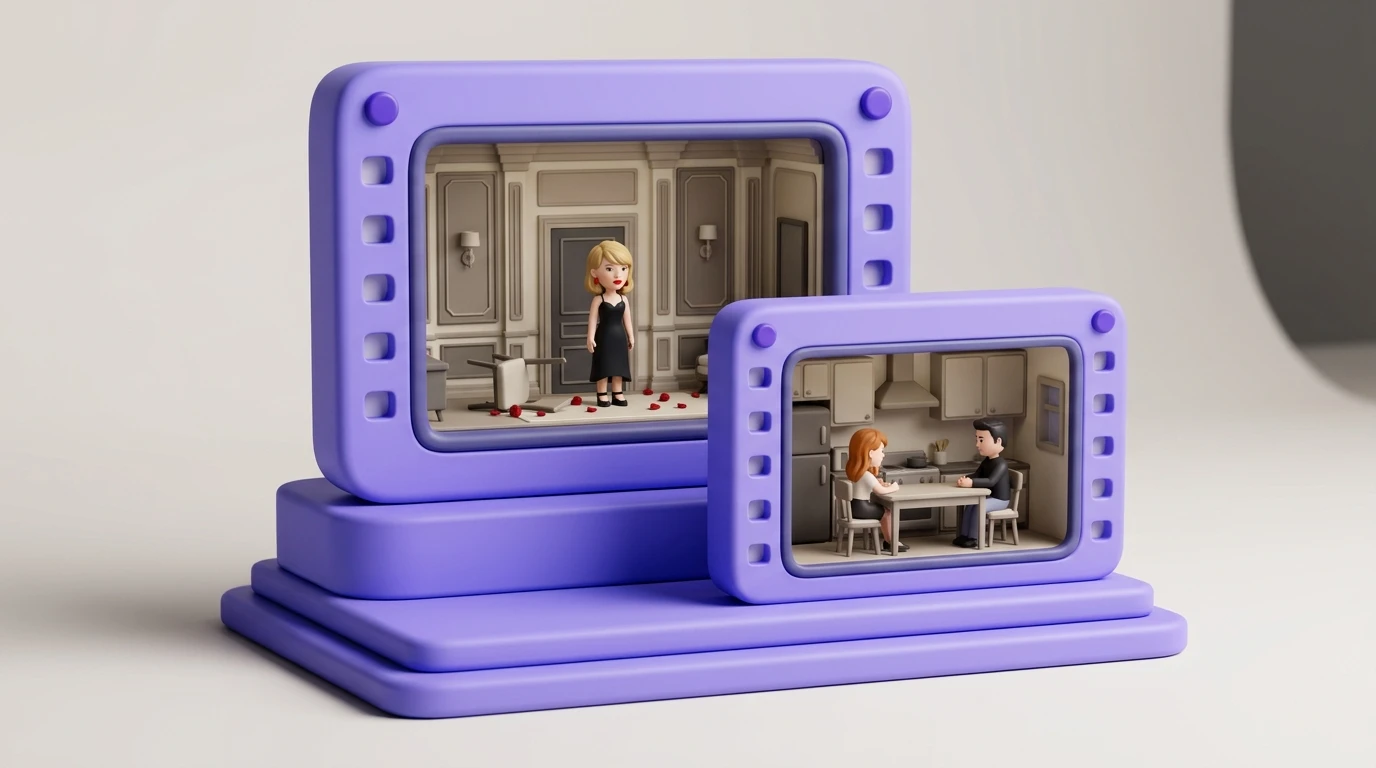
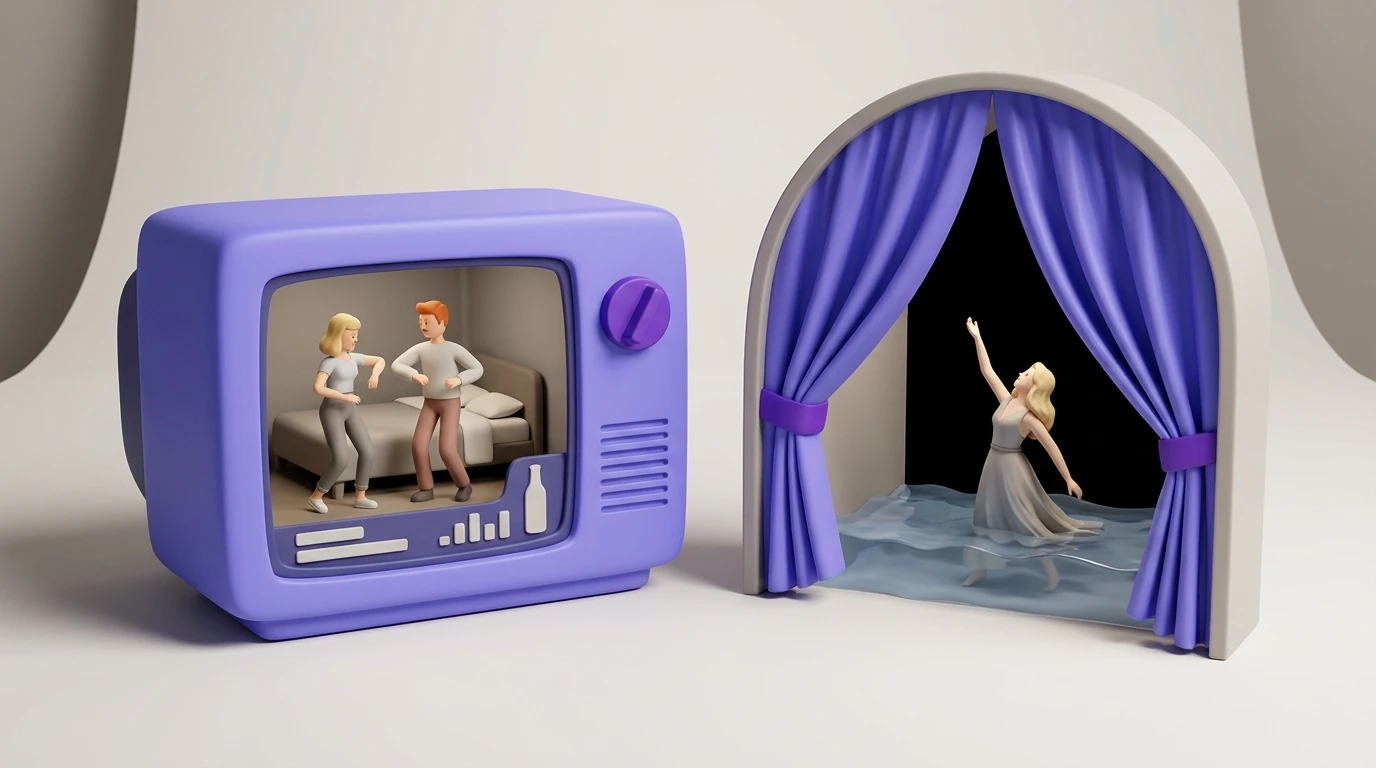
The Opalite music video uses a 1990s-style TV advertisement to frame an awkward romance. “The Fate of Ophelia” takes a more theatrical route, with water imagery raising the emotional stakes. One makes connection feel disarmingly ordinary. The other gives it the scale of a rescue.
- Read the retro advertising in “Opalite” as part of the story’s comic logic, rather than treating its period styling as decoration.
- Compare how the performers occupy each world. Awkwardness creates intimacy in “Opalite,” while theatrical presentation heightens “The Fate of Ophelia.”
- For your own video, choose a recurring visual element that can change meaning across the full song. Test that progression before adding more locations.
Where to watch the official videos
Watch the full versions through Taylor Swift’s official video catalog, checking the uploader before using a clip for comparison. Fan edits can change the sequence, while short excerpts remove the setup that makes a later scene work.
Spotify is another place to check. Its music-video support guide explains availability and how to switch between audio and video where the feature is supported. A missing video option does not necessarily mean the film is unavailable elsewhere.
Use the same viewing conditions for both videos. A phone crop and a full-width master can give very different impressions of choreography and the space around a performer.
How the two videos build different worlds
“Opalite” builds its world around a comic premise. “The Fate of Ophelia” works at a heightened emotional scale, using theatrical presentation to make the song feel larger than an everyday encounter.
That distinction matters more than deciding which video looks more expensive. Each establishes a visual language that tells the audience how to read the performance.
| Directing choice | “Opalite” | “The Fate of Ophelia” |
|---|---|---|
| Entry into the world | A retro television-commercial setup | A tragic literary association reframed through pop spectacle |
| Emotional register | Playful, with awkwardness left visible | Dramatic, with danger and release given greater weight |
| Performance style | Comic timing and hesitant connection | Choreography and heightened presentation |
| Role of artificiality | The commercial’s manufactured promise becomes part of the joke | Theatrical staging gives emotion a larger physical form |
| Useful creative lesson | Give ordinary behavior a strong premise | Give an emotional change a clear visual scale |
Our Taylor Swift music videos ranked for visual direction takes the wider catalog view, but this pairing offers a more specific directing lesson. A convincing visual world needs a consistent rule for what belongs inside it.
A strange advertisement can belong in a comic romance. A heightened performance can belong in a story about escaping a tragic fate. The direction succeeds when the surrounding choices support that rule.
Why the Opalite music video needs its retro setting
The retro setting makes the advertisement feel like a familiar kind of promise: buy the product, fix the problem. That gives the film a comic structure before the romance has to carry the story.
We read the product pitch as a joke about packaged solutions to loneliness. The characters’ awkwardness supplies the friction. Connection remains messy even when the advertisement makes transformation look easy.
The bedroom setting also brings the scale down. Private longing sits beside the exaggerated confidence of a sales pitch, giving the video room to move between vulnerability and comedy without abandoning its premise.
The useful directing choice is tonal consistency. A performance that became effortlessly glamorous throughout would weaken the awkwardness that makes this world distinctive. Leaving room for ungainly movement lets the romance feel approachable.
For an artist working with a limited production budget, that is a valuable distinction. A recognizable room can carry a strong concept when the behavior inside it is specific. Adding locations will not automatically make the idea stronger.
How The Fate of Ophelia makes the stakes larger
“The Fate of Ophelia” uses theatrical performance and water imagery to establish a more dramatic register. Beside the comic world of “Opalite,” its emotional language feels closer to peril, survival, and release.
The title supplies a literary shadow. Tate’s catalog entry for John Everett Millais’s Ophelia describes the Shakespearean drowning scene behind that famous image. That provides cultural context for the title, without establishing that a particular shot directly recreates the painting.
The distinction matters. Recognizing an association is different from proving an influence.
Our reading is that the water raises the emotional stakes, while the theatrical presentation gives transformation a visible form. The performance can occupy a larger space because the world has already established that heightened scale.
The comparison of The Life of a Showgirl music videos places these choices in their broader release context, while this pairing shows how differently spectacle can function. In “Opalite,” visible artifice invites amusement. In “The Fate of Ophelia,” it supports emotional intensity.
Turn the comparison into a usable video brief
The practical lesson is to choose a visual rule before collecting attractive shots. That is especially useful when a finished single needs a full-song video quickly and a location-heavy shoot would strain the budget.
Say your track moves from withdrawal to cautious hope. You choose a late-night room and an unplugged lamp as the recurring object.
At the opening, the performer sits beyond its reach. During the chorus, they move toward it. By the final chorus, the lamp is on and the framing gives them more space.
That borrows the ordinary-object approach of “Opalite” without copying its advertisement. It also gives emotional change a visible scale, using light and performance rather than a succession of unrelated sets.
Follow this order before building the shot plan:
- Write the emotional change. Finish the sentence, “The performer begins by feeling ___ and ends by choosing ___.”
- Assign that change to something visible. Decide how an object, setting, or repeated action behaves differently at the ending.
- Test the progression against the full track. Mark where the image changes, then check whether the essential action still reads in the intended social crop.
Use this brief to keep the concept intact:
Track:
Starting emotional state:
Final choice or emotional state:

Visual world:
Recurring object or action:

Opening image:
First meaningful change:
Final payoff:

Performance style:
What must stay visually consistent:
Essential action that must survive the social crop:
Keep the emotional change legible before expanding the production. Our guide to music videography from treatment to final master covers the broader workflow, including how a written concept becomes a finished edit.
A looming release date makes this discipline more valuable. Locking the central idea early reduces the temptation to solve every weak moment with another disconnected image.
Frequently Asked Questions
Who is the guy dancing with Taylor Swift in the Opalite music video?
The actor is Domhnall Gleeson. His performance fits the video’s awkward, comic approach to romantic connection.
Does the 1990s styling establish an exact year for “Opalite”?
The styling alone does not establish an exact year. Read the retro advertisement and wardrobe as period cues unless an explicit date supplies something more precise.
How many views does the Opalite music video have?
There is no permanent view count. Check the live total beneath the official YouTube upload, since the number changes and reuploads have separate totals.
The lamp example gives a finished track a visual progression that can hold across the whole song. If you want to develop that kind of brief into a full-song master and social-ratio adaptation with one creative director, get in touch with SongTrailer. Bring the emotional change first. Let the production serve it.